403 replies on “10 Things you may NOT know about the low FODMAP diet“
Nan
Hi Kate,
I have recently found the low FODMAPS diet and it has changed my life!!!!! Thank-you to Elise’s blog, and then I found you on line. I live in the Boston area and I would like to consult with you – is that possible? Can my physician write a referral? I could use some help navigating this new path….
It is a great diet approach that has helped so many people! Yes, you can consult with me. My office in Boston is in West Roxbury and the phone # is 617-469-4000. Hope I get to meet you!
My physician gave me a FODMAP list yesterday. I definitely do have IBS. Can you give me a list of dieticians in MA, north of Boston. I live in Pepperell, MA and I work in Bedford, MA
Mavis, yes, I allow pork sausage if there are no other FODMAP ingredients such as onion or garlic.
Gail
Kate, I couldn’t find your email address…so i hope you see this email. I may be in denial, but I still am wondering if light soy milk by SILK or Whole Foods (365 brand) Is acceptable on a Low Foodmap diet–Thanks! Gail
Gail, if the silk milk contains whole soybean and I believe that to be the case in the 2 brands you mentioned–then it would likely contain FODMAPs. The only US brand that I know might fit the criteria is 8th Continent.
Zoe levitt
Hi Kate
My Dr. recently told me about the FOD diet and I just found your site! Thank you very much for taking the time to do this. I will spend the next week or so educating myself about this diet and I have happily subscribed to your blog. Your blog makes me feel supported in my effort to learn about a different way of eating. Anyhow I wanted to ask you if wheat berries are low FOD?
With thanks, Zoe
Yes, brown, white and baked white potatoes are low FODMAP.
Helen
I am trying to follow the fodmap diet on my own but find I could benefit from the help of a dietician. Can you recommend someone in southeastern MA? I live in Lakeville and am handicapped so can not drive long distances.
Thank you so much for this site. I am beginning to follow this diet to the letter. Although I probably don’t have IBS I do have dyspepsia (4 months since onset) and after tons of gastro tests to rule out other diseases my doc has suggested I follow this diet. I am so glad you are keeping it updated. I have already found that enzymes do cause pain for me. I will also drop the probiotics and check labels more carefully on other items. Although I have some food science background I will also seek out the assistance of an R.D. if I can find one familiar with FODMAPS in my community. Again thank you. You are doing people a great service. Mary
I am planning to start the FODMAP diet Monday. I live in Alaska and there are no dieticians here familiar with the diet. How critical is it to have a dietician? Do you know any one here who can help?
Hi Mary,
Because the diet has so many little “rules”, I do think it is best undertaken with the help of a registered dietitian. I do not have any contacts in Alaska, but perhaps you could contact the local hospital to see if their is an RD that is knowledgeable in the low FODMAP diet.
Debbie, My colleague Patsy Catsos has a registry of FODMAPs knowledgable RDs in the US–check out her site http://www.ibsfree.net
Kathleen
Hi Mary, I live in Alaska too and when my doc at ANMC sent an ANMC dietician to me ( my doc was also familiar with fodmap diet) he gave me the fodmap diet. I find it hard to believe that there is not a single RD familiar with fodmap diet here in Anchorage. Maybe you could call ANMC for further information…? I also bought The IBS Elimination Diet and Cookbook by Patsy Catsos, MS, RDN, LP for further info. There are many books on Amazon about FODMAPS diet and I just looked at the ratings and read comments and thus bought this book. Good luck!
Hi kate, heard from some website brown rice flour/brown rice contain fructans which is unsafe.. So for items containing brown rice flour, are they safe for frucmals?
I look at the Australian research as the primary source of my information and when they analyzed brown rice it only had a trace of fructans so, I consider it as safe.
Hi Kate,
Question regarding beets. I noticed having a few slices are okay according to your list. What is your opinion on both juicing a beet and using one when making a vegetable stock?
Thanks!
Beet root has fructans and GOS if used in a stock they would leach into liquid and you would then consume them…if you added just a few slices as allowed that would be fine, same for juicing.
Soy sauce has minimal carbohydrates (fodmaps are carbs) whereas soy beans and soy flours would be more problematic and much more significant FODMAP sources.
From what I understand, the processing of tofu from soybeans minimizes the fodmap content and the Monash team have put it in their low FODMAP shopping guide. In normal serving size it should be a low fodmap food.
Barbara Robbins
We already use Tamara, a wheat-free substitute, for my husband who is celiac. Seems like it would contain fewer carbs and be better tolerated?
Hi,
In the March 14 post from Mary, she states she is dropping her probiotic. You are generally a proponent of probiotics that don’t contain FODMAPS, correct? Thank you. Lisa
I think most of us could benefit from a probiotic–but finding the right probiotic is not a one size fits all approach. Some of my clients seem to be better without one. Probiotic science is still in it’s infancy so we still have a lot to learn. For what’s it worth, I use a probiotic only when my symptoms of IBS get aggravated and very sporadically otherwise.
I have really bad IBS. I’ve been taking yourbiology. At first I loved it. Then like two weeks I had to cut down to one a day and work my way back up to two a day though. Now I take it all the time. The constant aching I had in my stomach is gone. Hope this helps someone too.
esther
Are goat cheese, fresh mozzarella cheese or feta cheese low in lactose and therefore allowable on Fodmaps? I know that you list mozzarella (and feta) on your low fodmaps shopping list, but I don’t know if the mozzarella is the fresh kind or the hard kind. I would love to treat myself and my husband to some fresh mozzarella, tomato, basil, and olive oil, but I don’t know if I dare.
Also, I’m a bit confused about feta. It’s on your shopping list, but perhaps the amount should be limited for me. I had an omelet yesterday with 2 eggs, a dash of lactose free milk, 3 kalamata olives, diced, a small tomato, diced, and about a 1/3 cup of crumbled feta cheese, all sauteed in a small amount of butter and olive oil. All were fodmap friendly ingredients, yet I bloated. Not the huge kind of bloat that I can get; more like 4 months pregnant than 9 months pregnant! Any suggestions as to the ingredient that might be the culprit?
Kate, in addition to my question above about fresh mozzarella and feta cheese and if they are high in lactose, is miso paste fodmaps friendly? Miso paste is fermented soy and is an ingredient in something kind of yummy that is sold at the local health food store that is OK re fodmaps on all other counts.
So excited to find this website. Can you please let me know if you addressed esthers questions on cheeses posted on 8/14/12? I am very curious what the answers are. Thanks!
Hi Susan, I am sorry I tried to find the comment you were referring to and couldn’t find it. I can tell you that most cheeses are allowed on the low FODMAP diet except particularly wet cheeses that still contain a fair amount of the whey (cottage cheese, ricotta) When cheese is made the proteins curdle and rise to the top and the whey –which contains the lactose is drained off. Cheddar, Swiss, Parmesan, even feta and brie are okay. The very soft mozzarella is okay too. Parm, Swiss and Cheddar have virtually no lactose while some of the softer cheeses may have 1-2 grams. Many individuals can tolerate some lactose in their diet–say up to 4 grams per sitting–but that is very individual.
Susan, Whey protein alone should be fine–as FODMAPs are carbohydrates not protein-but sometimes products labeled whey protein concentrate vs. whey protein isolate may have some lactose. I know…it’s a bit confusing.
If it is whey protein–if it is simply the protein should be low FODMAP.
Lorrice Gordon
Thank you so much for the info on cheese. This diet was recommended to me because of some intestinal surgery. I was already freaked out about going gluten free and lactose free. Knowing I can eat some cheese will make it so much easier! I found this blog so helpful.
Mike Gonzalez
Hi, I’m just starting out on a low FODMAP diet and about 50% of the websites I check say cottage cheese is OK while 50% of the others say it is high FODMAP. I honestly don’t care too much about cottage cheese because I have very rarely eaten it, but this creates an issue with me trusting the rest of the foods on the website lists. Is there an official list of high FODMAP foods to avoid so that I don’t have to keep guessing if what a website is telling me is correct or not?
Welcome to the gray area of FODMAPs. FODMAP content is very portion driven. The amounts and foods are still be defined. I will say, try not to get too micro with the diet. I think my checklists are a good go to. Having used them for years with patients–with good results–I think they work well. Other good resources–Monash U blog and app, Patsy Catsos’ site. The three of us keep things up to date. Some medical centers are out dated–and although a great resource for medical info–may not be for FODMAP info.
So to get more micro with your answer, a few tablespoons are likely low enough in lactose to be tolerated –but I tend to tell patient to avoid during the elimination diet in larger portions.
Diane Walker
Kate,
Thank you so much for the great information on your website and book. After 1 year of suffering from complications from food poisoning I am finally getting back on track following the FODMAP guidelines. Could you clarify for me about King Arthur Flour. This is the flour I have always bought (being born in VT!) It is on the shopping list for low FODMAP foods but wheat/flour in on the HIGH Fodmap food list. Any advice would be great.
Thank you for all your helpful information! I just stumbled upon this FODMAP diet while doing research on IBS and it makes sense. I would like to approach a new style of eating with the expertise of a dietitian but I am having a hard time finding someone in the western part of our state (MA). Could you recommend someone out here?
Thanks.
Hi. I am looking for a substitute for tomatoes that is fodmaps friendly. I used to make “no-mato” sauce from beets and carrots but i bloat even after removing the garlic from the recipe (replaced that with garlic infused EVOO). Also, are ground flax seeds safe? I make microwave gluten free muffins with Jorge Cruz’ recipe but am flying blind on flax.
Beets are one of those moderate/high FODMAP foods so they could still be causing you some symptoms in a sauce…can you make it with only small amount of beets and heavier on the carrots? The only data I have on flaxseed is in a mixture more commonly used in Austrailia called LSA (Linseed, Sunflower, Almond mix)– Linseeds are Flax. So in that mixture the cut off is 1 Tablespoon. So I think if you keep the serving of flax per serving –1 Tablespoon you should be okay. Hope that helps Lia.
Olive that would be correct and thank you for bringing that to my attention. One Australian Tablespoon is more than US–it’s like a Tablespoon + 1 teaspoon.
LA Rosen
This info on flax is very useful. We’re trying to get a bit more fiber back in the diet, but very carefully. Breakfast is usually rolled oats with small amount of safe fruits (bananas, blueberries, pineapple), a bit of nuts (pecans or walnut pieces) or a swirl of peanut butter or pumpkin; and lately we’ve added a tsp or two of freshly ground golden flax. Trying to monitor, but hard to know if whatever transpires through the day is from breakfast, or the lunch 2 hours later, or the mid-afternoon snack…. Trying to keep to just one new thing, or increased portion a day. We’ve also started trying very well rinsed quinoa (cooked in homemade broth) at dinner for added protein. Your site gives so much added useful info. Thank you for creating and monitoring this valuable resource.
Lindsay Willard
Hi! Can u recommend a dietician in So cal that is familiar with fodmap? My 7 year old has FM and ongoing SIBO. The dietitians at pedi hospital regurgitate info off the Internet and try and help but I need someone who can help us as my child refuses to eat and feels miserable- thank you so much! Maybe we could come to you? If you could help us I would seriously do it. Thanks, Lindsay Willard
Lindsay, Have they treated your daughter for the SIBO?
It’s hard to eat when you have SIBO–food often = pain.
I reached out to a colleague at UCLA med center–would that work for you?
Let me see what I can find out.
I occasionally do Skype or phone consults so if you can’t find someone close to your home–which is always best-then perhaps we could consider that route.
Best to you!
Hi! I have SIBO and I love my Dr. At Cedars Sinai. His name is Leo Treyzon. Very kind.
Good luck!
Ashlee
I was just diagnosed with IBS on Friday and told to follow a low FODMAP diet, can you send some recommendations as I do not eat beef or pork only chicken fish and shrimp, please help
Nicole, It can be helpful for those with Crohn’s disease. Particularly because individuals with Crohn’s are at higher risk for malabsorbing fructose. But, I would encourage you to seek assistance with the diet from a knowledgable dietitian.
Hi Kate,
I’ve been experiencing IBS-like symptoms for the past 6-8 months (although not diagnosis has been made, many other things have been ruled out by lab tests).
Have decided to try this diet plan to see if I see any alleviation of symptoms (mostly a lot of bloating).
I’ve heard mixed things about sweet potatoes (concerns with mannitol). I’m disinclined to give them up because they’re a pretty big part of my diet. Any insight? I stick mostly to Japanese sweet potatoes.
Hi Isabel. Sweet potatoes are a source of mannitol and this is a sugar alcohol (Polyol source.) Mannitol malabsorption is less common than sorbitol so perhaps you will tolerate them just fine. Many of my clients have been able to tolerate other mannitol sources such as cauliflower and mushrooms.
If you could try to limit to 1/2 cup serving at a sitting–you will be under the mannitol limit–perhaps try that for the first 2 weeks of the elimination phase and then try to re-challenge your diet with the sweet potatoes at that time.
You could have 1/2 cup sweet potatoes 3 times per day –as long as you spread them out over the course of the day.
Many yrs ago when all the autoimmune problems started for me, a GP told me most likely the bowel problems I was having were IBS. Not till recently when BLOATING AND PAIN became so prominent have I decided I NEED to really check this out…and my Living Without Magazine had that article about you and wala, FOUND your blog and such..ordered both your book and Patsy Catsos..am looking forward to learning a new way of eating to be painfree. THANKS for all you are doing!!
So glad you came by my blog Linda!! And I am so glad Living Without did a feature on FODMAPs–just wish more media outlets would talk FODMAPs! And glad you think Lucy is a adorable….she is cute and a HANDFUL!!
Hi Kate,
I have been battling IBS for the past 8 years. I eliminated all dairy from my diet for five years, but continue to have symptoms. Just learned of the FodMap diet from a friend of a friend. As with most people, this is seriously effecting my life. Can you recommend a dietician who is in the Portland, Oregon area? Thank you!
Hi Cindy, my colleague Patsy Catsos has a dietitian registry on her site and I have attached the link here–>http://www.ibsfree.net/FODMAP-Friendly%20Dietitian%20Directory1.pdf
There is one RD I believe on the above link from Portland.
Discuss the possibility of small intestinal bacterial overgrowth with your physician too as I find many of my IBS patients suffer from this condition as well.
I have a question about sugar made from beets. Is that okay or not okay on low FODMAPs? (I seem to have special intolerance, within FODMAP diet, for beets).
Also, what about beetroot fiber, which is in some gluten-free flours? I seemed to have a bad reaction after making a cake with that kind of flour. Could that be the culprit? (It also has tapioca, sarrasin (buckwheat), and carob). Thanks!
I believe beet fiber would be a FODMAP source. What I have seen about beet sugar–it appears that it would be okay and allowed BUT I have not seen actual Monash data on this –so use with caution.
I’ve just startet on a FODMAP diet and bought four different kinds (and brands) of gluten free breads for the occasion. They do however all contain sugar beet fiber. Your blog has the only mention I can find of beet fiber and FODMAPs. Do you (or anybody) know anything more about it?
Pete–not sure we know much about sugar beet fiber & FODMAPs. Would suggest you try Udi’s white sandwich bread –which at most recent check seems to be suitable….and has been well tolerated by my clients. The whole grain Udi’s seems like it might be okay–small amount of molasses but should might be okay. I have noticed that food manufacturers are adding sugar fibers and corn fibers–and I can’t say for sure that these would be suitable on the low FODMAP diet.
talli
Thanks, that’s helpful to know that beet fiber and beet sugar could act differently!
Another Q: I just saw a comment about flours and thickeners on low FODMAPS. It was about adding agar agar (derived from seaweed), and also grass jelly (cincau – a plant) powder as thickeners. http://fodmapsdiet.com/2013/01/11/pancake-for-one/#comment-1651
Do you know if either of these foods are okay for low FODMAPS?
Thanks for the helpful blog, Kate. I’ve been on the low fodmap diet for a few years (through ShepherdWorks in Melbourne), and am thankful for the dramatic reduction in IBS pain. We’ve moved to Switzerland, and now have the challenge of reading ingredients in other languages! There are a number of products I find it difficult to buy here, e.g. debittered soy flour. Can you suggest a substitute?
I am not sure I would use soy flour due to FODMAP content anyway–I like buckwheat flour, brown rice flour, potato starch, oat flour as my favorite options.
Hi Kate. I was just doing some Googling for “buckwheat fodmap” and found this post. I love buckwheat flour for baking and I’ve read it has tremendous anti-cancer attributes. However, the Monash app lists only buckwheat kernels (which would then just be ground into flour), and it lists them as high FODMAP. Has there been an update to the status?
Elizabeth–I have not seen data on buckwheat flour—but may be different depending on the processing and the fiber content left in the flour product. Buckwheat kernels are limited to 1/4 cup–this would be the whole grain.
I posted this just now but didn’t have the notify by email part checked. please respond to/approve this and not the other.
I’m on week one of the elimination phase and I keep having this odd experience where gluten free products that looks safe on the ingredients front immediately tingle going down. The only thing I can come up with so far is that they both were made with flours which are resistant starches.
I have found a lot of material suggesting that resistant starches act like the F in FODMAP.
Resistant starches are fermentable in the colon–so they can cause gas. They are made of longer chains of carbohydrates compared to FODMAP–so are not as likely to pull water into the intestine as FODMAPs do.
Tamara
Kate,
I live in San Bernardino, CA. Can you recommend a knowledgeable RD in the area.
hi kate,
a lot of useful info on this blog.had an illeosecal resectioning in 1998.doctors never established what exactly is causing my continued symptoms-diarrhea,bleeding,sore rectal area (proctitis?).have done a number of tests,colonoscopies etc etc bla bla.i seem to be sensitive to most foods prohibited on the fodmaps diet.also to fried foods,all cereals,all soy products-the list of foods are far greater than the list of foods i can tolerate.any suggestions on what to eat in order to cure/improve a sore rectum and fluctuating blood sugar levels (my villi seem to be not functioning properly after years of being aggravated by foods i shouldn’t have been eating)?also-how to get rid of ongoing diarhea and improve my bowel motions?and finally-a good r.d. to contact here in melbourne.thanx so much!
I would recommend you see a dietitian and gastroenterologist to help you work through your challenging symptoms.
You are lucky to be in Melbourne as this is the hub of all the amazing research in the world of FODMAPs. I believe Jaci Barrett is at diet solutions. http://dietsolutions.net.au
I just found your site today while researching FODMAPS info. After years of gastro visits, testing and failures, I have figured out that I have a gluten intolerance, so have been avoiding that for 3 years already. I normally eat a very vegetable/fruit/protein/dairy diet, but have recently started a Whole30 (sort of Paleo) that also restricts sugar and dairy. Since starting it, and obviously eating more protein and vegetables than normal, my stomach is very distended and feels full all the time, exactly like when I eat gluten. I have always wondered about onions (they give me a headache when cooking them, so I’m thinking my body is telling me they’re not what it wants) and sometimes garlic is offending as well. I live in Hopkinton, Ma and would love to get involved with someone that is familiar with these kinds of issues. Are you local (I saw Boston) or can you recommend someone else that might be? Thanks, Kristin
Hi Michele, I don’t have a specific recommendations for a dietitian in Sydney…but I am sure there are many FODMAPs knowledgable dietitians there. Perhaps reach out to Catherine Saxelby she is near Sydney and may be able to help you! http://foodwatch.com.au/about.html
Oh yes, Michelle, the Monash University low FODMAP diet app is very user friendly and such a great tool for patients and health care professionals alike. I am so grateful that the Melbourne, Australian researchers put it together.
Hi Kate,
My 6 year old has had an ongoing issue with constipation and GERD. He has been treated for both but without a lot of success. Recently he was tested and found to have Bacterial Overgrowth Syndrome. He is now on his second round of flagyl but experiencing a lot of nausea and gas. His GI suggested the Fodmap diet. I noticed he eats some of these foods in large amounts (Watermelon, milk, pasta, apples, cheese). Do you think just elimating the foods he eats a lot of would give him some releif or do you think all food listed should be avoided? Thanks for all the wonderful information.
Kristen, I would encourage you to work with a dietitian. It wouldn’t be prudent to advise you via the blog on what’s best for you son without understanding his normal intake, nutritional needs, past medical history etc…and this is done thoroughly with a dietitian. That being said…I find it’s best in most circumstances to do a complete elimination diet for 2 weeks to get a better understanding of what foods are problematic. Certainly in the elderly,malnourished and pediatric population, for example, the full elimination diet may be too restrictive and I would opt for a more liberal approach and simply limit the foods most often consumed with the highest amount of FODMAPs. Hope that helps. Of note, ensuring adequate fiber in those with IBS-C (constipation) is key from my experience. Here is a little info on low FODMAP choices and fiber content: http://blog.katescarlata.com/fodmaps-basics/fiber-without-fodmaps/ Also, chia seeds are a great source. 1 TB has 5 grams of fiber!
I have been an IBS sufferer for along time now, and find its very debilitating. I am also Lactose Intolerant. I have just found out about FODMAP. Which meats should I avoid? Are there any types of FODMAP friendly, lactose free milk brands available that I can use in recipes. I am finding this transition very difficult and know that I must stick to it in order to get my life back. Can you recommend any books/recipe books?
Thank you.
Hi Missy, FODMAPs are carbohydrates and meats are carb free so all meats are allowed…unless of course, prepared with FODMAP containing ingredients such as honey ham for instance–honey is a FODMAP. Lactose free yogurt such as Green valley is well tolerated. Lactaid milk and lactaid cottage cheese should be okay too. For review of the elimination phase of the diet, IBS Free by Patsy Catsos is a great book and for recipes I have plenty on this blog but also in my low FODMAP downloadable cookbook link here: http://www.katescarlata.com/fodmap.htm
Almond milk is being tested now.
Not sure if it will be suitable as many of my clients can not tolerated.
Louise
Still in diagnosis stage but GI reccommended FODMAP diet. Can you tell me if Mirin would be tolerated on diet? Also Splenda? What about roasted garlic? My tests came back negative for Seliacs and lactose intolerance. Have yet to take fructose test, CT entrorography and endoscopy but main symptoms are diarrhea. Some bloating. It sounds like the people with IBS have more problems with bloating. Also colonoscopy did not show any abnormalities.
Louise,
My guess is that Mirin as a sweet wine would not be low FODMAP. I am not a fan of splenda but it should not be a FODMAP. There was one study that suggested it reduced beneficial gut bacteria. Fake foods for all of us, should be kept at a minimum, right? The low FODMAP diet is very helpful in the management of diarrhea so hopefully it will help you out.
Thank you for the information. I am trying to navigate a lot of information. I just finished a six week low residue fiber diet and so many foods I could not eat on that diet are allowed on FODMAP and vise versa and it is all so confusing. BTW- the low fiber diet did not help at all. So the allowable sweeteners on this diet are maple syrup and sugar. Is that right?
I am just about to begin this diet I was diagoised with IBS and have massive bloating when I eat so I am hoping this will help relieve some of my symoptoms. I live near the Washington DC area and was hoping you could refer a great dietician I could speak with.
Hi,
For some reason my Q from Feb 15 was not answered. And I’d love to know if you have any wisdom.
It’s a Q about substances often used in desserts or as thickeners. Is agar agar (derived from seaweed), or also grass jelly (cincau – a plant) powder allowable? I saw this (unanswered post) about the subject here: http://fodmapsdiet.com/2013/01/11/pancake-for-one/#comment-1651
Do you know if either of these foods are okay for low FODMAPS? Thanks!
Several years ago my Gastroenterologist diagnosed me with Chrons and six months ago said he made a mistake and that I had IBS. Well, I have had IBS for many years and a year ago was tested for food intolerance. Results showed that I am Gluten intolerant, casein, lactose, egg yolks coffee and many other foods. Fatty greasy foods also make me sick. Walking outside for exercise is impossible and I dislike mall walking. I love to travel and that has also become very difficult. I first saw FodMap mentioned in Living Without Magazine and am very excited about finally having something to help me. I live in Wisconsin and need to find a diatician who can help me. The Gastroenterologist has been no help. Do you know of anyone in the Appleton, Green Bay, Madison area? In September we have a Pilgrimage scheduled to France and I would like to have this under control before then.
Hi Kate,
I just ordered your book and one other on IBS. my doctor has not given me a diagnosis yet, but I took the fructose test this week and my hydrogen level was four times higher than normal range. I am now looking at information on fructose malabsorption information. I did not test high for lactose intolerance. Would you still recommend the strict FODMAT diet? I checked for a dietician in NM on the web site and there are none listed. Louise
Louise, be sure to be tested for small intestinal bacterial overgrowth which often goes hand and hand with fructose malabsorption(FM). Typically, yes, the diet for FM would be a low FODMAP diet for 2-6 weeks followed by the re-challenge phase to evaluate which FODMAPs trigger symptoms.
Kate, Thank you so much for your help. When I return from my trip I will ask my GI about the test for small intestine bacterial overgrowth. I had been scheduled for a CT entorography (sp?) and cancelled. I hope that was not the test for bacterial growth. I just wanted to make sure I was not doing a lot of unnecessary tests. The nurse from my GI said they were requesting a referral for a dietician. I feel I am on the way to better days. Thanks again. Louise
Hi Louise, the small intestinal bacterial overgrowth test is typically a breath test. So happy to hear you will be working with a dietitian. Good luck and YES…on your way to better days!
Hello Kate,
Your blog, cookbook and shopping list are true Godsends for me and my husband, who is suffering from something ever since he took a round of Cipro in December after contracting an intestinal bacteria when we were in Panama. The Gastroenterologist ordered all the tests she could think of but really wanted to go for the colonoscopy. When he resisted she mentioned trying a low FODMAP diet. It helped almost from day one. We are adjusting reasonably well because there are so many decent foods in our local co-op and I like to cook. Turns out giving up soft cheese has been difficult though. What is the rule on goat and sheep products? I know they have different proteins…
Thank you!
Sandy
Hi Sandy, It’s true, the casein in goat milk products is easier to digest for some…but this is not a FODMAP relationship–as FODMAPs are carbohydrates. Goat and sheep milk would not be allowed due to the lactose content BUT cheeses made with goat or sheep milk should be okay as long as they are not too ‘wet’ meaning that some of the lactose was retained in the cheese. It the cheese is creamy–small amounts such as a couple tablespoon crumbled on a salad should be low enough in lactose.
Hello Kate… my husband returned from the doctor today and she suggested he start following the low Fodmap diet. He suffers a lot from the issues that you discuss: IBS. As a newbie [as of today], what do you suggest I do first? I plan on contacting a dietician in my area [SF bay area CA] but what else should I do while we wait? Any advice would be greatly appreciated! I’m off to read more from your website! Thank you… Mari
Mari First be sure you husband has been screened for celiac disease. It’s always important before you take wheat out of the diet -even for the short term-that he be tested for celiac which can have some overlapping symptoms with IBS. Celiac testing is inaccurate without wheat in the diet. Patsy Catsos’ book, IBS free at last is a great reference when starting the diet. And of course, work with a (FOdMAP knowledgeable) dietitian to ensure your husband is doing the diet correctly and with healthily.
AFter trying 4 rounds of different antibiotics, the FODMAPS immediately took care of my IBS. Now I need to figure out how to put foods back in. Any dieticians recommended in the Philadelphia and surrounding suburban areas?
This website is AWESOME! I am day 20 on my Whole30 challenge and recently discovered the low FODMAP diet. I initially started Whole30 to ease my IBS troubles, and so far my stomach actually feels worse =(. I did some research and found out about FODMAP and the whole shebang behind it. I have the bloaty, gassy, gurgly, dread eating kind of IBS and I am sick sick sick of it. Whole30 has it’s benefits ( I do sleep a whole lot better) but I am still having issues with my stomach. As soon as I am done with Whole30 I plan on committing to the FODMAP elimination diet to see if it helps. Unfortunately I can’t find any local Houston, TX dietitians who specialize in FODMAP so I figured maybe someone on here can help me out. Any pointers, advice, resources, support would be GREATLY appreciated! I also have a food journal/blog and document everything I eat on: whole30fortheworkingirl@blogspot.com, if you check it out maybe you can give me some pointers as to what I’m doing wrong?
I am very new to the low FODMAP diet and am trying to figure it out. I have Celiac Disease that is well controlled and already know that I do not tolerate hardly any grains at all. I am wondering if dried (unsweetened) coconut is allowed. What about unsweetened coconut milk? Thanks.
I’ve just been told about the Lowfodmap diet and am trying to work out what foods I can eat.This site is very enlightening because the questions are often those I had not thought to ask.
Great site,thanks
Hi Kate, My husband has cholangiocarcinoma and watery diarrhea usually after eating. The doctors say the secretory diarrhea is caused by the chemo and he has lots of meds for it, but it is an ongoing problem. I am trying the fodmap plan because he eats lots of carbs due to taste changes. Do you have any suggestions that might be helpful?
Hi Pat, I wonder if it might be possible to meet with a dietitian in your area that specializes in digestive health. It seems to me that your husband would benefit from a nutrition evaluation and take into account his medical history to find a nourishing, tasty and easy to digest diet for his health condition.
I have just discovered your website and think it’s truly enlightening. I live in London UK and am looking for a nutritionist/dietician who is really conversant with the FODMAP diet. Finding that a bit tricky so wondered if you had met with any while doing your own research?
Lynn- Kings College London runs a FODMAP course for dietitians. I have reached out to Emma Carder who practices in the UK and is very knowledgable in FODMAPs to see if there is a list of dietitians that have taken this course. Stay tuned.
Hi, after 2 years of stomach pain for my 6 year old, I just discovered this list and have already found that the things with high FODMAPs are exactly what make him sick and in pain on the couch for hours. The only time he felt ok in the past 2 years was when I gave him a broad spectrum digestive enzyme before each meal. ( I did this for 3 weeks). So, I know he needs to follow this diet. My question is- why can he not eat things on this list? I know IBS is one reason…what are some other reasons. I want to get to the bottom of WHY he cannot eat these foods with out the help of a digestive enzyme. He saw a GI dr for the first time yesterday…she thinks he is constipated..sigh..( even though he pooped 19 times last week) she obviously has no clue.
Hi Amy, first be sure your son is tested for celiac disease. This can be done with a blood test for an initial screening. It’s important before you remove wheat from the diet to test for celiac because the testing is not accurate once wheat, barley and rye (the gluten containing sources in the diet) are removed on the low FODMAP diet. People are sensitive to FODMAPs if they don’t absorb them well. This could be due to small intestinal bacterial overgrowth–the bacteria creep into the small intestine and break down the FODMAPs before they have the opportunity to be digested. Some FODMAPs are not digested by the human body: Fructans and GOS so are often culprit for GI symptoms. Lack of digestive enzymes such as lactase can make lactose, the sugar in milk products non absorbable and thus become food for bacteria. When intestinal bacteria consume FODMAPs they produce gas. In individuals with IBS –a motility disorder—the gas can become trapped causing pain or the gas can be created in the small intestine which has a narrow diameter and so the stretching of the intestine might contribute to pain as well. The doctor may feel stool in his intestine which she is relating to constipation. Many IBSers don’t empty the intestines completely which also plays a role in their symptoms. The gases produced by consumption of FODMAPs by bacteria can play a role in slowing down the intestine (methane producing microbes are linked with this) or sped up by hydrogen gas producing microbes (gut bacteria). It’s complicated biology in the gut!!
I want to sample onion next but wondered if you had any ideas as to what Type of onion would be best to try and maybe what Amount, if that’s important too….ohhh and Cooked or Raw!?
I am pretty excited about this test as along with garlic, something I used to eat a lot off.
Hey Jade…Onion seems to be a very hard challenge to pass for many of my clients. I have not seen data on different types of onion so I would try the onion you most enjoy. Stick with small amount cooked or raw, though some find cooked better tolerated–the test amount is 1 Tablespoon. I can enjoy traces of onion in foods such as salad dressing but not big chunks in foods–but everyone is a bit different. Best of luck to you!
Hi, my 6 year old has been gluten and dairy free for 7 months. He was doing so much better, but now he is sick all the time again. I have found that he NEEDS to be eating low FODMAP foods in order to feel well. I am so glad I found this site! But, I have a question, he is going to be tested for celiac. Do you know of a low FODMAP food I could give him that does contain gluten? I know Cheerios are FODMAP friendly, but are not gluten free.Any other suggestions for what I can give him? He has to be eating gluten daily for 12 weeks in order to do the biopsy to check for Celiac disease. I want to keep him as low FODMAP as possible to reduce his pain, but he needs to be eating gluten! thanks so much.
Amy, I would encourage you to ask his doctor but a few low FODMAP foods with gluten would be 100% spelt bread (whole foods has a brand, French meadows), soy sauce, seitan (gluten rich vegan protein source), small amounts of wheat pretzels might be okay too–try 1/4 cup regular pretzels as a snack (Monash allows these on their app), you might also try sourdough white bread (many of my clients can tolerate it when we do a wheat challenge) or Bay’s English muffins which are a white wheat based English muffins, in the refrigerator section of the grocery store that many of my clients can tolerate too when we do the wheat challenge.
Hi Kate, many thanks for creating such a great online resource. I’ve just started the FODMAP diet this week, I’m a vegetarian, and it is tough. But the improvements I’m feeling already more than make up for it, or though I was heart broken when I discovered I couldn’t drink camomile tea 🙂 One thing I found on another site detailed do’s and don’ts for vegetarians and one of them is –
‘Don’t: Stay on the elimination phase for more than two weeks. You need to liberalize your diet sooner than meat-eaters in order to get adequate nutrients.’
If you follow the diet and include tofu, tempeh, and small amounts of allowed legumes: 1/4 cup canned chick peas and 1/2 cup canned lentils I think you might be okay to stay on it a bit longer BUT…once your symptoms are managed–and that may only take 2 weeks–you should start the re-introduction/challenge phase. It also depends on if you include eggs, cheese and lactose free milk which would allow for greater variety and nutrients.
That’s good to hear, many thanks. I didn’t realize I could eat some chickpeas, that’s made my day! When you say ‘once your symptoms are managed’ do you mean completely IBS free? My first few days with the diet saw a huge improvement but now in the second week the IBS has come creeping back. The only foods that don’t cause any symptoms are rice, eggs and potatoes, which is obviously a very limited diet 🙂
Jade
Hi Kate,
Well it’s been a time since I started my FODMAP experience but with the help of your recipe booklet, within days, I was happy to discover that I was on the right track! Finding FODMAP saved me where nothing else would.
I have come to share my re challenge! results…..
Honey – symptoms returned 2 days with nausea.
Wheat – symptoms returned with nausea and stayed for 5 days.
Garlic – 1 whole clove fine (haven’t tried more yet).
Onions – symptoms back for 2 days – no nausea but bloated.
Lactose – (I was already lacto intolerant)
And a question regarding…..
You made an interesting point before that the difference between SIBO being present and Fructose malabsorption is sometimes clear when the FODMAP foods are brought back.
I have since been interested as to what this meant and how SIBO would show itself.
I was really interested in what you thought of my results. My thinking is that my ‘suffering’ would have been a lot worse if it was SIBO.
(I did have a breathe test for SIBO and it was negative, showing both low levels of Methane and Hydrogen.)
However just in case the results where inaccurate….I am all ears as to what you think….Are my results typical of a food problem rather than SIBO?
BTW – I should say to anyone reading FODMAP has helped me 10 fold.
I haven’t had a chance to scoot around the whole website in a while because I have had my head in the fridge most days :D…..but looking forward to trying the banana, cinnamon, coconut recipe!
I hope the world of food is treating you kindly…..
Hey Jade! So happy that you found the recipe booklet helpful! Yay! Not sure about sibo –but seems like you had symptoms but not terrible symptoms–is that correct? You might try a sourdough white bread–many of my clients have found that works for them. I personally wouldn’t push the garlic—I mean who needs more than a clove anyway? Sounds like you passed that one! Onions are tough for most people so no surprise there.
Thank you so much for your informative and very helpful website. Is there a problem with the alcohol content of pure vanilla extract and a low fodmap diet?
The Monash researchers have allowed vanilla in their recipes so I allow it as well. I am not sure they have analyzed vanilla extract. I think the small amount of alcohol should be okay for most people.
I just realized that they aren’t the same as fructans, really deceiving on the Monash app for your phone they class them all in the same category…think they should have a separate ‘class’ for the galactoligos.
Thanks
Gail Tauber
I need a NYC dietician–any to recommend?
Also anything you recommend for nausea associated with iBS/Dyspepsia?
Gail, Sometimes seeping a small piece of ginger root in hot water and making a tea to sip can easy nausea. Have you had a gastric motility test to rule out delayed stomach emptying?
NYC based RD I recommend is Tamara–http://www.tamaraduker.com
I’ve noticed a link on google to your website mentioning apple cider vinegar but cannot find the page. So you may have already written about this somewhere…anyway.
Probiotic choice should be based on research. Typically I do this by looking at what symptoms the patient is experiencing and what probiotic has a proven track record (research based) for that symptom. Align and culturelle (without inulin) are often chosen by my clients. Often its a trial and error approach because we all have a unique gut bacteria ‘fingerprint’. There are other probiotics supplements that may work–here is a good overview on probiotics. http://www.worldgastroenterology.org/assets/export/userfiles/Probiotics_FINAL_20111128.pdf
My gastroenterologist put me on a low residue, gluten and lactose free diet for IBS, SIBA, and diverticulosis. My RD suggested the FODMAP diet and it has really helped.However, no raw fruits or vegetables(per my dr) is extremely restrictive. May I gradually add them to my diet? I have stage 4 breast cancer with bone metastases so am worried about proper nutrition.
Phyllis, I can not provide individual dietary guidelines in a blog format. I would advise you to discuss your concerns with the health care team that is working with you.
I make my own chicken broth and not sure I have officially posted a recipe! Let me work on that one! I vary up my recipe but this is one variety: I add water to a large stock pot (about 8-10 cups),1-2 bone in chicken breast (about 1/2 pound each) some parsley, carrots, a celery stick, small lemon, peppercorns, a few scallion slices (green only), thyme and salt. Let it boil for 5 minutes and then simmer for about 30 minutes on medium-low heat. Turn off heat to and let the chicken slow cook for another hour and then strain broth-be careful it will still be warm. Use chicken to make chicken salad or other dish that suits you.
After suffering stomach pain, horrible gas, bloating, etc for two years, and undergoing every possible test the GI Dr could come up with at least once, most of them twice, I had a “medical assistant” suggest that I follow the FODMAP diet, by googling it. I did so (carefully) for 2 months, never adding dairy, and felt SOOO much better. So, I assume I have IBS. When the end of my 2 months came, I added only white bread/flour (1 serving on an occasional day), and nothing else. Then after several weeks of eating almost the same thing every day (not adding anything), I started getting the symptoms back again. I don’t have a dietician to help me, so I’m lost as to what to do next. It’s not only the days that I eat white flour, it’s every day, some days worse than others. Do I go back to wheat-free? Or where can I get the help I need? It was so nice to be symptom-free with my weight steady. Then I suddenly gained 3 lbs in one week…I guess from the bloating. Help!
Janet, You could use the help of a dietitian that specializes in digestive health and nutrition. Can you try to find one in your local area? Where do you live? I can try to find you someone. Have you been tested for small intestinal bacterial overgrowth?
Carolyn, US pumpkin is undergoing testing. In the Australian info, ‘pumpkin’ often refers to what we would call in the US squash….so I sent them 4 cans of US pumpkin. I hope to learn soon if it is okay.
Hello Kate, I think I wrote this before but don’t think it posted. I was wondering if pickles (if bought from a farmer’s market so they are homemade with no added sugar or garlic) are low FODMAP? Thanks for whatever guidance you can provide, Linda
Absolutely love your website and blog, thank you!! My husband has been following the low FODMAP diet for 6 weeks now and feels so much better. We are waiting for our RD appointment set up by his gastroenterologist which is still 1 month away but he would like to start reintroducing some foods now. Wondering if you could suggest any foods that would be preferable to reintroduce first? I would like to choose wheat since that is one that would make cooking and eating a whole lot easier. Your thoughts?
Thanks Shari–glad you like my blog 🙂 I typically don’t start with wheat first–but you could if you are truly missing it. I would start a ‘gentle’ wheat challenge by adding 1 slice of white sourdough bread while maintaining otherwise a low FODMAP diet. Then, if no symptoms–up to 2 slices of white sourdough bread on day #2. I encourage my clients to purchase a sourdough bread at Whole Foods or one with limited ingredients– only FODMAP friendly ingredients (besides the wheat). If on day 3–no symptoms he could try 3 slices at a sitting. Other wheat challenges that you could try Day #1 1/2 cup cooked pasta Day#2 1 cup cooked pasta Day#3 1 1/2 cup cooked pasta Wheat prepared with sourdough culture or white varieties seems easiest to re-introduce from my experience. Weight of bread can play a role too–if you eat a ‘heavy’ or dense roll for instance–by weight you would be eating more fructans–so opting for a light and airy bread may be better tolerated. Make sense?
I had rectal cancer surgery a year ago. The cancer was all removed as was a portion of my rectum. I have had bowel issues constipation and the loose stools since then. My doctor suggested trying a low FODMAP diet. Do you know of anyone else who has tried this with success? Thank You.
Hi Judy, Yes, I have has excellent luck with colon surgery patients and the low FODMAP diet. My major caution is that the low FODMAP diet lowers bifida bacteria populations which are linked with decreasing colon cancer risk–so the diet should be used short term–with the goal to try to get some of the fructans/GOS foods that increase these healthy gut bacteria population back into the diet.
Hi Kate,
Just have a question about making your own stock. If I use celery to make it but strain it would this be ok? I have seen other recipes that only use the leaves so I thought maybe the polyols might be water soluble and therefore not ok?
I like to eat winter squash, but it can be hard for me to digest. Is acorn squash, spaghetti squash, and kobacha squash low FODMAP. Also what do you think about taking digestive enzymes?
Tamara–butternut squash has a fair amount of FODMAPs–both mannitol and GOS so needs to be limited to 1/4 cup, diced or less! not too much!
I have not seen data on the other squashes. I think digestive enzymes are appropriate for some individuals who may actually be deficient in enzyme production–I don’t believe everyone w/ digestive health gets benefit from taking them.
SIBO testing is typically done in a hospital setting–big city hospital–not typically in the suburbs. But that seems to be changing as more hospitals are acquiring testing equipment. It might be done in a Gastroenterology Motility Lab or Department–if there is one. There are also home breath kits that you can use –but your health care provider would order it for you. Commonwealth labs is a Massachusetts based company- their test kits have been validated to some degree by Mark Pimentel–he compared results from Comm Lab kits vs. his equipment. http://hydrogenbreathtesting.com
Just wondering if tahini is considered low fodmap? Some resources say no others say yes but i’m confused because sesame seeds are considered low FODMAP so surely something that is made from 100% sesame seeds should also be low FODMAP?
There is increasing evidence that foods high in FODMAPs actually prevent IBS symptoms rather than promote it by creating healthy bacteria necessary to digest these FODMAPs.
Finally, is the Monash book more comprehensive than the iPhone application do you know? I find that the application is SO limited. For example, where would Barley Grass fall?
can you please advise on re-introduction of fodmaps where the main problem is constipation (followed by a day of frequency). Its hard to tell if the first sample of tested food has caused “symptoms” because of the time factor involved in constipation! So I never get past day one and learn nothing! Of course there is bloating too but again I am never sure how long after eating the “culprit” this would be expected to occur! I would so appreciate some guidance on these time factors, many thanks
How I do it: The test food should be added back once a day for three days. Get back to your baseline b/4 challenging a new food. Typically GI effects would be felt sometime during the day (w/ in 3-4 hours) of trialling –but constipation predominant patients are sometimes harder to read–and symptoms can take a bit longer.
Hi, I just started the diet 2 days ago and I am learning to cook differently. Is coffee ok to drink and how about black teas like earl grey? Thanks. Linda
Coffee seems okay for most of my clients and is allowed in reasonable portion (1-2 cups). Black teas seem well tolerated too. Note that caffeine can stimulate the intestine to move–so adjust to your personal needs.
Thanks. I don’t seem to have a problem with it but I was wondering.
Sue
Hi,
Are popcorn (homemade), soy sauce and corn syrup as a sweetener in food (not partially hydrogenated) allowed on the FODMAP diet? My 18-year-old son just started it and is already getting frustrated about the lack of snack options.
Sue, I allow popcorn but have not seen actual data on it. I know it has been included in some of Sue Shepherd’s books. Soy sauce is okay and as far as we know corn syrup is okay BUT not high fructose corn syrup.
Got it. HF corn syrup is evil. We cut it out of our diet years ago and my adult acne completely cleared. We live in the Boston area and my son is headed to BU in the fall, so we may contact you for an appt. Thanks so much for your quick reply.
Erin G
Wow! You are remarkable! I have suffered with digestive issues since I was a teenager. Now, 17 years later I’m starting to make sense of it all. I am confused on bananas, though! How do I tell–from looking at the green/yellow exterior–when the banana is the safest to eat? How many are safe in a day? The online data is confusing and Monash calls them by two separate names. Something like sweet banana and common?
Thanks again–You’re a Digestive Genius!
In the US, the banana in the app would refer to common banana. Ripe or unripe would be suitable on low FODMAP diet. Unripe has more starch and that can lead to gas in some people–depending on the nature and location of gut bacteria.
My son’s SIBO test was inconclusive, but he started with a high hydrogen baseline and had pain after the test, so the GI prescribed Xifaxan (Pimentel protocol dosage). He’s been on a strict FODMAP diet for almost two weeks with mild improvement. As per Pimentel (from your blog!), I know he should cut down on that while on the antibiotic. But how much? Eat completely normally? Just add a few wheat products or onions?
I hope you can advise as we have to wait a bit to see a nutritionist in person.
Hi Sue, I have not seen a definitive protocol…for liberalizing the diet. I tend to have my clients add small amounts of FODMAPs–1/2 an apple and some garlic and/or wheat to their day — I don’t want to fully exacerbate their symptoms but do want to have some ‘food’ for the microbes. More research is needed in this area!!
I know the RDs at this location are FODMAP savvy…http://www.evolutionrd.com/Locations.html If you make an appointment ask for the dietitian that does the most FODMAP consults.
Hi…I have just come across this website whilst trying to find some answers for treating gastritis. I have awful indigestion and at times, crippling stomach pains.
I live in England and would love to contact a dietician about FODMAP but can’t seem to locate one. Doctors here just give tablets with no further advice. I have become so confused about the right foods to eat as some are suggested for gastritis and then totally banned on the FODMAP plan.
I am completely confused and suffering badly…any help please?
Christine, not sure my response posted. I would check w/ Emma Carder in the UK –a colleague of mine and dietitian: http://www.emmacardernutrition.co.uk
I really got a lot from your wonderful website and greatly appreciate the time you put into it. The Fodmap diet definitely helped with the gas and mild constipation that I experienced. My other problem is weak anal sphincters. Can this diet help the muscle tone over time, since there’s less irritation?
I have been on the Fodmap diet for about a month now. I felt better the first 2 weeks with much less gas and a calm stomach. The symptoms have returned these last 2 weeks though. Any thoughts why that is happening? I am also dairy free and I don’t eat meat or chicken so I may be eating too much of what it left. The diet is very restrictive and boring for me and now I feel that it is not helping. I appreciate any advice and insight. Thanks,
Linda
Hi – help!
I have undergone numerous tests to find a cause for extreme constant bloating, nausea and lower abdominal griping pain plus upper stomach soreness and bloating. Everything has come back as normal (apart from mild gastritis).
I had similar but lesser problems 8 years ago which went on for 3 years until it just went away for no obvious reason.
I am (usually) a very fit active person running, triathlons etc but due to how rubbish I feel I have gained weight and lost my fitness. None of my clothes will do p and I look 6 months pregnant all of the time. I’m currently re-training to be a personal trainer and am now concerned this could affect my career. The gastroenterologist mentioned FODMAP but nothing further has come of it. Could I try without dietician support? Is it only for IBS or could it help with my sytmpoms? Apologies for long post. Thank you for any advice.
Larissa, the low FODMAP diet is evidenced based for use in the patient with IBS –but certainly may help individuals with bloating. I would check out King’s College London site to see if there is a dietitian to help you decipher your best dietary intervention. Additionally consider breath test for small intestinal bacterial overgrowth.
Thank you so much for all the great information!
I have to take an antihistamine against my allergy to pollen and in most of them is lactose monohydrate included. I am lactose intolerant, but the pharmacist told me that the amount is so small that it might not cause symptoms. I am not sure about that- I have different symptoms although I am on Fodmap.
Is there a problem with it? Could you recommend an antihistamine without lactose monohydrate?
Just finished my antibiotic regimen for SIBO and am embarking on a Low FODMAP diet when I found your website. Very informative. My doctor suggested either SDC or Low FODMAP and based on a few hours of research on the internet, the Low FODMAP looks more appealing and something that I can easily manage into my lifestyle.
I look forward to visiting your site frequently for updates and new ideas.
Thank you!
Thanks so much for the information! I’m new to this and still in the elimination phase. One thing I’m not clear on: if I can’t tolerate, say, a particular fructan does that mean I won’t be able to tolerate all other fructans? Or is it a question of how much, ie. is it possible I’ll be able to tolerate a food that’s lower in fructan?
Also, what is it about almond milk?! I had a severe reaction to that, and yet almonds are not a fodmap food.
Louise–tolerance to foods within the same group may vary–this is for a few reasons–some foods contain shorter or longer chain fructans, some foods in the ‘fructan group’ have more fructans than others, some foods might have fructans plus GOS in them–upping the total FODMAP load. So try different foods within the group before you say you can’t eat ANY fructans. I find many of my clients can tolerate a slice or two of sourdough white bread. Onion, on the other hand, is a bit more difficult for them–especially raw onion.
Almond milk is likely high FODMAp–though we haven’t got a definitive on this yet–it’s still undergoing testing–is likely a big source of GOS and fructans. This is because almonds contain both fructans and GOS–they are allowed on the low FODMAP diet in a 10 almond limit… BUT when you make almond milk you add LOTS of almonds –then add water—and the fructans and GOS (which are water-soluble) can leach from the almonds right into the milk…then into your intestine…..and you know the rest of that story… Hope that helps! 🙂
Hi Kate, Have you found one nut that is lowest fodmap and best-suited to make milk out of? I have been using walnuts to make milk. I’m vegan and am working to find a good alternative. I have seen rice milk listed as the best alternative but I struggle with SIBO issues, too.
Thanks, I just tried Vermints too and they seem okay. The sweetener is cane juice
Heidi Hansen
Thank you so much for all the info – my doc has told me to try this diet. I am going for a coeliac blood test in 2 days time, I stopped eating wheat on Sunday, should I still eat it until then for the test?
Thank you
Yes, continue eating wheat until after the test. You may found you tolerate sourdough bread better–so try to stick w/ that–the sourdough can lower fructans (FODMAP source) but the gluten is still in the bread…or try 100% spelt bread which has the gluten but tends to be lower in FODMAPs as another alternative.
Thanks so much for all of the great information. I have suffered from digestive issues my entire life, chronic constipation, looking like I’m always six months pregnant and having a stomach ache every single day! Over the years I’ve tried so many natural/holistic approaches (homeopath, naturopath, colonics, traditional chinese medicine, every fibre supplement imaginable, dietary changes – gluten free, dairy free) with nothing really making a difference. Tired of the fight I went to see a GI specialist last week and he tested for Celiac disease. I’m glad to report that it’s not that, so he suspects IBS with constipation. He recommended taking Restoralax daily which I’m not comfortable with. He also suggested a new “pill” on the market I believe it’s constella, again not interested.
The one great suggestion he made was to take a look at the low fodmap diet. I’ve done a bit of research and was quite overwhelmed with the discrepancies out there on various food items. Your lists and recipes are extremely helpful, so thank you so much!
I have a dietician that I’ll be working with next week in the area (I’m from Toronto, Canada) so I’m hoping she can help as she is aware of the diet.
I know that the diet is based on carbs so fat sources in moderation should be fine, but I found one site that listed margarine as a high fodmap source so I was a bit confused. Is there margarine with lactose in it maybe? Perhaps you could clarify. I checked my Earth Balance Soy Free spread and it states it’s lactose free.
Thanks again! I’m excited to go shopping with my new list in tote. I imagine it’ll be a longer excursion than normal as I carefully read through every label!!
I am confused about oatmeal/oats. I know it should be naturally gluten free however those with celiac and other disease are concerned about cross contamination. For those simply following low FODMAP, are all brands ok if ingredients are simply oats? What about granolas that list rolled oats?
Eileen–gluten free oats would be essential for a person with celiac disease but if ONLY following the low FODMAP diet–then you could use regular oats–the amount of wheat in cross contamination is not a problem for the low FOdMAP diet alone. Rolled oats would be okay for low FODMAP–but note–limit is 1/4 cup dry or 1/2 cup cooked.
I had my first appointment with an RD concerning the low FODMAPs diet. I had one question she couldn’t answer so she directed me to you. I really enjoy uncured bacon, but since starting the low FODMAPs diet I have found that every package of uncured bacon lists celery powder as an ingredient in lieu of sodium nitrate. I have checked multiple stores and it is printed on every bacon label. Is celery powder OK to have? I typically only eat 2-3 strips of bacon at a time. I am currently on the elimination diet and will be starting reintroductions soon.
Meg, Not sure that celery powder has been tested. I have seen celery powder added to bacon as well–the uncured varieties. I might try a piece and see if you note any symptoms. If no symptoms, try 2 another time.
My daughter started the low fodmap diet today (microscopic colitis with diarrhea as the only symptom) and I’m wondering about why it’s not healthy to stay on the diet long term. Is it because it prevents healthy bacteria from growing in the gut? Also, what are the most beneficial foods to reintroduce first to rebalance the body?
Thanks so much!
Maryse, The low FODMAP diet has been shown to reduce some of the healthy bacteria in our intestine. We don’t know what this means for our long term health…much more research is needed!! The fructans and GOS increase these healthy bacteria–so perhaps trying to add back small amounts of food choices with these FODMAP sources will be the long term goal. The science of diet and our gut bacteria populations is exploding now–but still very much in its infancy.
Hi, I’m debating trying this diet on my own, to see if I can get relief from my symptoms, but I will be doing it solo, as there is no one around me well versed in the FODMAP diet. I was wondering, the moderate fructans and GOS that are allowed, can they be included during the elimination phase? I know my IBS (self diagnosed), is anxiety related, so wondering if this diet will help or should I not bother until I see someone regarding the anxiety? Thanks for any advice.
Nicole, My recommendation is to NEVER self diagnose. Seek medical assistance. You don’t want to miss something that could warrant medical treatment or other dietary modifications–such as celiac disease or inflammatory bowel disease.
I was just on the Quest website. I’m wondering if you think the protein bars are ok on the low FODMAP diet? I just found them and they don’t seem to have any high FODMAP ingredients(http://www.questnutrition.com/protein-bars/)…Also they have protein chips which seem ok-they have milk protein isolate but I think when it’s protein isolate it’s ok? Would love your feedback on this as I’m finding the low FODMAP diet a very carb-heavy one-I would really like a safe protein snack!
The ingredients of the chips are below:
INGREDIENTS: Protein Blend (Milk Protein Isolate, Whey Protein Isolate), Dried Potatoes, Corn Starch, High Oleic Sunflower Oil. Contains less than 2% of the following: Sea Salt, Calcium Carbonate, Natural Flavors. CONTAINS: Milk Derived Ingredients.
Hi Rachel, First of all—do you best to stick w/ real foods vs. products. Many real foods in their natural state have been tested for FODMAP content–not too many products–so it’s hard to know for sure about various bars etc. Occasionally grabbing a bar on the run–is okay–but wouldn’t make them my main stay. Ingredients wise the bars don’t seem too bad –but I am not a fan of sucralose–and they add it.
The chips seem okay. Calcium carbonate can be constipating though–not sure why they add it. Safe protein rich snacks: Cheddar cheese chunks, peanut butter, a hard cooked egg, lactose free yogurt, handful of lower FODMAP nuts.
Xanthan gum is a longer chain carbohydrate–so not a FODMAP. FODMAPs are small carbs. But..it is a rapidly fermentable carb–creates gas quickly–so can cause symptoms in some people.
Also, I’m wondering about tomatoes. They are on the Low list but I see some posts here about people limiting them. Are they ok, or limited? What about tomato sauce and purees?
Kate,
Thank you for putting all of this info into one place!
Following is the ingredient list for Earth Balance’s Original spread:
Natural oil blend (palm fruit, canola, soybean, flax, and olive oils), filtered water, contains less than 2% of pure salt, natural flavor (plant derived from corn, no MSG, no alcohol, no gluten), pea protein, sunflower lecithin, lactic acid (non-dairy), and naturally extracted annatto for color.
Is there any ingredient in here that gives you pause in regards to FODMAP?
Thank you,
Beth
Beth, I don’t know too much about pea protein. It’s probably okay–but that would be the one ingredients I would question. I have had clients use Earth Balance products, however, without an issue.
I don’t suspect I’m having an issue, but with being new to FODMAP I thought it would be prudent to ask. 🙂
I was just looking through some of your recipes. The breakfast bar recipe made with the Mesa Sunrise cereal contains corn syrup, yet corn syrup is listed as high. Could you please clarify whether it’s okay to use or not?
Thank you!
Corn syrup is a grey area. High fructose corn syrup is a definite NO…but plain corn syrup likely varies from one brand to the other. There are many products with regular corn syrup in the US and many of these are well tolerated. I allow the Mesa Sunrise cereal.
I was mistaken–it was in the comments section of the breakfast bar recipe where you suggested someone use a little bit of corn syrup to thicken up the peanut butter in lieu of marshmallows (I hope I got this right this time!).
Thank you, though, for clarifying about the corn syrup. It means I can have an occasional fun-size Snickers bar and not worry. : )
Is Turbinado sugar allowed (evaporated cane sugar)?
What can one take with a sore throat since they all seem to have high fodmap sweeteners?
Can we eat meats like ham, bacon, and salami or is the curing/smoking process a problem?
Should we consider all dried fruits off limits during elimination phase? raisins, craisins, apricots..?
Turbinado sugar should be okay. Ricola looks okay for sore throat– the lemon mint variety–it does contains some herbals though –which I don’t really know too much about! Curing and smoking should not pose a problem as far as I know from FODMAP perspective–but I recommend these sometimes higher fat/salt foods as an occasional treat rather than a daily food. I allow small amounts of raisins and dried cranberries (1 tablespoon per serving) as outline in the fabulous Monash app.
hi Kate, I am fructose intolerant and have a question about sucrose please. I know it is half fructose so should it be limited to 6g at a sitting to meet the recommended 3g fructose limit imposed on fruit etc? And if I have a piece of low fodmap fruit should anything containing sucrose also be excluded at that meal? (I have a sweet tooth & don’t want sucrose to unwittingly be my downfall).
Many thanks as ever.
Hi Kate, I’m currently running a campaign to bring awareness for coeliac disease and gluten intolerance. I know a lot of people on FODMAPs find that gluten is the cause for their problems. I have just made a post about the relation of FODMAPs and Gluten Intolerance – I thought it might be of interest to yourself and your followers! https://takingcoeliacseriously.wordpress.com/2014/10/06/the-low-fodmap-diet-and-gluten-intolerance/
Hi, I too am wondering about the fructose content in table sugar, are raw sugar, white sugar, caster sugar all the same in fructose content?
Also my dietician told me I could use agave syrup and coconut flower nectar but as far as I know they are both quite high in fructose?
I have had Lactose intolerance ruled out, from an endoscopy but do I still need to beware of this for another reason in the elimination stage of this diet
Melinda–table sugar has an even amount of fructose and glucose. Glucose helps fructose absorption–so when fructose and glucose are present in equal amounts OR when the glucose content is greater than the fructose content–those foods should be well tolerated and low FODMAP from fructose perspective. BUT everyone has their own person fructose load threshold. SO –choose foods that don’t have excess fructose BUT also be sure to limit to one serving of these fructose containing foods per meal. One banana OR one orange for instance would be a good serving–avoid eating a large fruit salad the size of your head, for instance. 🙂 If you use table sugar–white sugar, raw sugar….keep the portion reasonable. 1-2 TB max would be a good limit. And yes, avoid coconut nectar and agave!!
I am still getting to grips with this program. Can anyone tell me 1) how long you need to be on the basic FODMAP and 2) once you start migrating foods back do you do one at a time and for how long?
Rose
Kate – so I have been trying the ‘elimination’ diet for about 8 weeks now and feel much better overall. Just for clarification, the elimination diet is a low-fodmap diet, not a no-fodmap diet, correct? I’m confused about the differences between those terms. I still have relatively mild symptoms at times but I think it is the result more of too large portion sizes of low-fodmap foods but figured I’d check in case I was wrong on this. Thanks!
I have recently been dx’d w/SIBO, about 1 week ago. I have been trying to follow the SCD diet but the initial stage or juice, mashed bananas and juice, still cause bloating and reflux and I still have diarrhea. I’m wondering if the FODMap would be a better way to go? Plus, the article you posted about the SIBO symposium, even suggests not changing my normal diet until I’m finished w/the antibiotics. I’ve spent days and hours researching and am so confused and disheartened. I have lost 7 lbs in the last 2 weeks and cannot lose anymore. I have been making all of my own food, including yogurt and broth. I live in Des Moines, IA, and my GI, tho being thorough and even re-running blood tests for malnutrition and thyroid again this morn do not mention diet. I have been sick since August, when we came home from England early. Dx’d back home w/diverticulitis, and just as I was regaining weight, caught a virus that went into a sinus infection, requiring more antibiotics. Now this SIBO. I also have a very low IgG level that is being followed by a hematologist. I just don’t know which way to go for diet or further follow up. Thank you.
Quick question on re-introducing polyols please Kate. Are dried apricots a good test only I see they contain oligo fructans as well as polyols? Many thanks.
Em, they do contain fructans though..I am not sure exactly how much. 2 dried apricots have moderate fructans and higher amounts of sorbitol. Blackberries might be a better bet for testing to do a more pure test. Food is complex–fiber content is variable and other factors can play a role. I do use both apricots and blackberries for a sorbitol challenge –but as I mentioned–blackberries would be best.
I have been on fodmap and it’s tough but getting better. I am having trouble with finding a protein supplement I can drink to get extra protein. They all have so many bad ingredients. I am lactose and fructose intolerant which makes it even harder. Is pea protein safe? and I have heard whey protein isolate could be lactose free as well?
Any feedback would be helpful!
The whey protein isolate should be lactose free–whey protein concentrate may have some lactose–though amounts vary.
Pea protein-I am not sure. Hasn’t been tested. Small amounts in Go Macro bars are well tolerated by my clients. For other proteins supplement to consider–check out my Pinterest board: https://www.pinterest.com/katescarlta/your-fodmap-kitchen/
Hi, I have just started the low FODMAP diet as my GP thinks I have IBS. I have been eating only low FODMAP foods for a week but my symptoms are no better and I have a headache most of the time. Is this common?
I had heard that you can feel worse before you feel better ?
Also, I am making my own bread with Spelt flour – is that ok on this diet?
Jane, I would work with a dietitian to sort out why you might be getting headaches on the diet. This is not a frequent problem I find in my practice. Some people do feel worse on the diet at first–but this is very rare in my practice. There are numerous reasons you may be getting headaches–but this would be best sorted out with a health professional!!
I have never been a big drinker but do miss having the occasional wheat beer or glass of wine (fructose and fructans are issues for me and I’ve been restricting these as I get my symptoms under control). I note that wine and beer are considered low-FODMAP. Would that still be the case for wheat beers? Or beers that have honey or molasses as an ingredient?
Also, I know that certain wines can be higher in fructose – do you suggest any types of wine that are easier on the stomach?
I have been dealing with IBS for nearly 40 years. My physician put me probiotics about eight years ago, on a gluten free diet about two years ago, and added low residue restrictions about eight months ago. He now wants me to add low fodmap restrictions. HELP! I have been trying to cross reference everything to see what I can actually eat. I am in North Alabama. Do you know of someone here that can walk me through this or are you able to do that from MA? Please let me know. Thanks.
Ali, I believe probiotics should be selected on evidenced based research and the patients symptoms. For my constipation patients–I like align for starters….for those who experience diarrhea–I find Culturelle–health and wellness formula works well. VSL#3 works for some —particularly if bloating is presenting symptom–starting at very low dose. BUT it is best to discuss your probiotic needs with a health professional that is aware of your medical history. Those with active small intestinal bacterial overgrowth–probiotics may be contraindicated–more research is needed in this population!
Thank you for all the information, your blog is such a helpful resource! I love and appreciate all the downloadable PDF resource guides you offer!
I have a question about drink mixes, I typically only drink water, but that gets old very fast. I was wondering if there are any calorie free drink mixes that might be safe to use? In particular I was hoping to get your input on this one: http://www.amazinggrass.com/store/green-superfood-original.html
Due to time constraints…I get 100s of emails per day–plus many blog comments–it’s impossible to answer ALL of the questions regarding many products. I wish I had more time..but lately…I simply don’t 🙁 So…if you have the food product ingredients–and you list them in a comment–and keep to one or two foods, I am may be more likely to respond. As the FODMAP concept emerges–more and more people are coming to my blog and find my email…and I WISH I could answer all the VERY important question you have!! Bottomline: list ingredients vs. sending a link–it saves time and I might be able to respond!
The ingredient list is quick hefty since this is a superfood drink mix and contains all kinds of vitamins/minerals. Since I don’t feel inclined to list all the ingredients as it might take some time, could you provide any recommendations on any calorie free drink mixes you use?
Hi Kate,
This is the list for sunwarrior protein powder:
1. Classic Vanilla: Raw Whole Grain Brown Rice Protein, Rice Oligodextrin, Vanilla Extract, Stevia, Xanthan Gum, Ancient Sea Salt, Pectin
2. Classic Natural: Raw Whole Grain Brown Rice Protein
Warrior Blend Vanilla: Proprietary Protein Blend (Raw Organic Pea Protein, Raw Cranberry Protein, Raw Organic Hemp Seed Protein),Organic Vanilla Extract, Natural Fibers (Fenugreek, Konjac), Stevia, Ancient Sea Salt, Medium Chain Triglycerides from Coconut, Herbal (Tea Leaf) Extract, Natural Citrus Extract, Organic Cinnamon Extract
3. Warrior Blend Vanilla: Proprietary Protein Blend (Raw Organic Pea Protein, Raw Cranberry Protein, Raw Organic Hemp Seed Protein),Organic Vanilla Extract, Natural Fibers (Fenugreek, Konjac), Stevia, Ancient Sea Salt, Medium Chain Triglycerides from Coconut, Herbal (Tea Leaf) Extract, Natural Citrus Extract, Organic Cinnamon Extract
4. Warrior Blend Natural: Proprietary Protein Blend (Raw Organic Pea Protein, Raw Cranberry Protein, Raw Organic Hemp Seed Protein), Medium Chain Triglycerides from Coconut
THANK YOU SO SO SO SO MUCH FOR TAKING THE TIME TO HELP US ALL IN THIS FODMAP JOURNEY!! You really are on of a kind. I find dietitians here in the UK are very jealous and selfish about sharing information for free.
Alex,The first one looks okay–but pectin and gums can be ‘gassy’ though not FODMAPs. I like the classic Sun Warrior protein powder. Not sure about the pea protein in the other options–especially as a primary ingredient. I have had client try Go Macro bars with pea protein and tolerate it fine–but not sure if the amount in the powder would up potential FODMAPs–just don’t know. I do have protein powders–including the classic Sun Warrior on my Pinterest board. Check it out here: https://www.pinterest.com/katescarlta/your-fodmap-kitchen/
Thank you for taking the time to answer. I appreciate it a lot. Will check you Pinterest as well.
Have a fab day,
Alex
Nicole
Hi Kate, how soon would I expect a reaction from eating a med/high FODMAP food? After following a low FODMAP diet for a couple of years, I now tolerate many FODMAPs fairly well and rarely suffer with bloating or diarrhoea like I used to before starting the diet. However I do frequently suffer with IBS-like cramps perhaps 1 hour after a ‘normal to loose’ but regular (1 to 1 1/2 days) BM. The pain is mild but can last on average for a couple of hours, then I feel OK. Does this sound FODMAP related and why does the pain happen then and not within hours of eating? Any insight from you would be much appreciated, thank you, as I cannot seem to find anything to explain this anywhere else.
Nicole, Sounds maybe like a bowel spasm. Typically–though one can not say for sure for everyone–FODMAP symptoms tend to be 15 minutes to 6 hours after eating.
Thanks so much for getting back to me so quickly, I’m very grateful. Is there anything I can take/do to relieve the bowel spasm? Do you think it sound FODMAP-related?
Paula
I am confused as to whether the following are FODMAP friendly or not:
whey protein isolate
kale
lettuce (as some websites say it is not ok)
edamame
apple cider vinegar
stevia
You’re website is great and I have the Monash app but some things are not on there.
Edamame would have FODMAPs–it’s whole soybean, Whey protein isolate–would be okay, low FODMAP. Apple cider vinegar–distilled–should be okay–but would limit to 1 TB max–have not seen data from Monash on it, Stevia is low FODMAP, Kale is low FODMAP, not all lettuce has been tested–I find my clients tolerate baby greens best–baby lettuce, arugula, butter lettuce.
I have had colitis for 5 years with daily diarrhea and just started the low FODMAP diet. I have read that insoluble fibre is generally bad for ulcerative colitis. There are many low FODMAP foods that are high in insoluble fibre such as spinach, collard greens, kale, lettuce, bell peppers, bok choy, eggplant, tomatoes, green beans, raspberries and strawberries.
Hi Rod, Depends on if the patient w/ UC is having active flare…insoluble fiber tolerance varies person to person. So, I really work individually with the patient and modify insoluble fiber depending on what is going on. I encourage you to work with a dietitian knowledgeable with IBD and nutrition care.
Hi Sara,
Tomatoes are low FODMAP but when you concentrate them and cook them down –say in tomato paste–the fructose content concentrates and tomato paste can be a source of excess fructose….small amounts such as 1 tablespoon should be okay–but not large amounts.
As always, thank you for always having the time to reply to all our questions.
1. I’m lactose intolerant, I was tolerating well authentic greek yogurt. I’ve been told to come off cow’s dairy because of inflammation and relation to auto immune diseases. I’m also lactose intolerant. I am allowed sheep and goat’s dairy, but I’m not sure about the lactose content. What’s your opinion on it?
2. What’s your opinion on the following UDO’s choice supplements:
Alpha-amylase 5000 DU (62.5mg)
Lactase 3000 ALU (37.5mg)
Alpha-galactosidase 260 GalU (29.9mg)
Protease 12500 HUT (25mg)
Cellulase 400 CU (11.5mg)
Lipase 150 LU (8.6mg)
Stem bromelain 50000 PU (1.7mg)
c) Beyond Greens Powder ( I guess it’s a no no…):
– Greens: Barley, Alfalfa, Oat and Rye Grass powders, Chlorella, Spirulina.
Defatted seed and fibre: Brown flax seed, sesame seed, sunflower seed, oat bran, rice bran, golden flax seed (whole), psyllium husk.
– Food Concentrates: Carrot, Soyforce™ powdered sprouted soybeans, tomato, beet powder, broccoli, kale, parsley, Udo’s Choice Ultimate Digestive Enzyme Blend powder (amylase, lipase, protease, cellulase, glucoamylase, invertase, malt diastase, lactase, pectinase (with phytase) and bromelain in a base of beet root fibre.
– Phytonutrients blend: Cinnamon bark, ginger root, peppermint leaf, bilberry leaf, licorice root, red clover blossom, lemongrass, artichoke leaf, dandelion root and leaf, rosemary leaf, thyme herb, standardized grape seed extract.
The reason why I ask about the sheep and goat’s yogurt, is because I read in some other blog (brand for sheep’s yogurt) that people with lactose intolerance DO tolerate sheep’s yogurt because apparently the lactose has been broken already. It seems to me more marketing that other thing. However, when comparing carbs content from goat’s to sheep, sheep does have less carbs than goat’s.
This is what I found:
“FACT 6
The lactose. Even if people are severely lactose intolerant, the lactose will have been converted into lactic acid if they take their sheep milk in the form of yoghurt and much of the lactose goes out with the whey in hard cheese making. There is also evidence that the lactose in sheep milk is more tolerated than from other milk and certainly worth a try.
Remember that any illness or any cause for the use of antibiotics reduces your immune system, however wonderful antibiotics may be, they usually kill the good bugs along with the bad. Yoghurt, especially Acidolphus yoghurt, helps to redress this and restore the gut flora back to its original load, all working to prevent” http://www.sheepcentre.co.uk/sheep_milk_facts.htm
What brand of coconut milk do you recommend? I notice the carton varieties have additives like guar gum and I was wondering if that could be problematic for IBS.
Anne, I used the canned light coconut milk…Trader Joe’s doesn’t have any added gums. Guar gum is not a FODMAP–but it is a fermentable carb and can cause gas.
HI, getting really confused about brown rice and 1-2 Tbsp a day of fresh ground flax seed, have IBS symptoms and definitely cut out wheat, sugars etc. and symptoms start to get better but have used flax seed for numerous yrs.(keeps things regular) and have never eaten much rice but running out of foods to eat. All these “lists” say different things. Any thoughts ?
I have been in denial for years that I have IBS but I am ready to get out of pain so I want to follow the diet precisely. I am a big cold press juicer. What herbs are we allowed to have. I saw ginger but can we have anything else like turmeric, mint, basil etc? Also, is there any difference with juicing foods vs eating them. I would love to have apples in my juice….fingers crossed. Also, you did not list almond milk, is this a no, no? Any suggestions on alcohol?
Thanks for this site. Love the clear and concise way it is laid out!
Your blog and website are life savers. Thank you!! Big problem with following FODMAP diet is being hypoglycemic and needing to have snacks in my purse. Many bars that are 90% good (no FODMAPS) will have dates, agave,or inulin from Chicory root. Since these would be in low percentages are they ok or am I sabotaging myself? So appreciate an answer to this!!
Thank you. Not wanting to be a pest but you are my only resource as the gastro doc is almost inaccessible. I have excema on my legs and to a lesser extent in small areas on my arms or torso. It has become excruciating at night preventing sleep with the itching and burning. I have always had very good skin with no problems. Is this possibly from the SIBO? Also can the bacteria overgrowth affect the bladder? I keep getting UTIs that are very resistent to antibiotics and just won’t clear up. I hate to keep asking for your valuable time, but I am really suffering. Thank you from my heart.
Hi Kate! I have been following the FODMAP diet for a few weeks now, and the difference is amazing! I accidentally ate something with garlic and onion in it the other day (didn’t know until after I ate that it was in there) and my IBS symptoms came back full force. If I’m intolerant to garlic and onion, would that mean I am intolerant to all fructans? Or do you test different types of fructans (wheat, fruits, etc) separately after the elimination phase? Thanks in advance for your help!
Jillian, definitely try different foods from the fructan group to assess your tolerance. I typically test my clients tolerance to fructans with onion, garlic AND sourdough bread. Then if sourdough works okay–I might try regular wheat bread.
Perhaps I missed it, Margaret. Not sure if I can answer a question about UTIs–but feel free to repost. I try to get to most questions–but can’t possibly get to all of them.
Basically the question that got missed was if SIBO can cause persistent UTI’s and/or exceed. (I have both and do have SIBO) Other important question:are maltodextrin and tamarin/soy sauce allowed? I have seen it both ways and they are in something I can otherwise eat and like. (Master crunch gluten free crackers)
Thank you again, Kate.
Hard to really answer that question Margaret–I would need to evaluate your full medical history to weigh in…something that I can’t ethically do in a blog format.
Thank you Kate. Can you tell me if Tamari and soy sauce are ok? Also maltodextrin. They are both in Mastercrunch gluten free crackers which are delicious but those ingredients concern me. Hope you can answer this. you are a real life saver.
Is Coconut Palm Sugar ok? There is an amazingly good cereal made from sprouted rice called Veganic Sprouted Rice Cocao Crisps that is sweetened with it.
Otherwise I think it is a perfect food for Fodmapers…. delicious with lactose free milk. Another one Maple Buckwheat Flakes that does have a bit of honey (last ingredient) and that I seem to tolerate. Wanted to pass on the good news.
Can you explain how to do the reintroduction of food on the low fodmap diet. Do you do individual foods or food groups. Do you break it up into l food a week or 1 every few days. How can you tell if you are having a reaction to one food when you try another, especially if there is no time in between? I can’t find any detailed information as to how to do this properly. I am going to a dietician soon but don’t know if she has experience with low fodmap. Thank you.
Tami, likely it would be a FODMAP source–but it doesn’t seem to bother my clients. Might avoid initially while on low FODMAP diet–and then introduce to assess better if it causes any symptoms.
Black beans have not been tested as far as I know. Canned chickpeas, drained and rinsed (1/4 cup) and canned lentils, drained and rinsed (1/2 cup) are considered low enough in FODMAPs.
Hi Kate,
My tests for SIBO and fructose malabsorption both came back negative, despite my symptoms indicating that those issues were highly likely. I had a high hydrogen baseline both times, which my doctor said could either indicate a slip-up in preparation for the test (but I ate only plain chicken and white rice) or could actually indicate SIBO. She suggested treating experimentally for SIBO. In related news, I just had an endoscopy to check for celiac disease because my symptoms came back severely when I did a 6-week gluten challenge after a year gluten-free. The biopsies were negative for celiac but my doctor found that I have gastritis and peptic duodenitis. She thinks it is caused by an overproduction of stomach acid; I was negative for h pylori. She put me on Nexium and back on the gluten-free and low FODMAP diet. So far the Nexium seems to actually worsen my symptoms. My questions are:
(1) Have you heard of high baseline hydrogen indicating SIBO?
(2) If a patient has SIBO, wouldn’t that include an under-production of stomach acid rather than over-production (making Nexium counterproductive)?
(3) Can SIBO cause gastritis and duodenitis?
Thank you !!!
I do see baseline high hydrogen on SIBO test results occasionally. It is often thought to be due to poor prep for the test….but my patients feel they prepped adequately—so not sure if poor prep is always the cause of a high baseline hydrogen. Some bacteria can cause inflammation–so yes, I believe, you can present with inflammation in SIBO. It could be that the Nexium is not the solution for you and exacerbating your symptoms. Sorry in the delay in getting back to you.
Hi Kate, I’ve just undergone a barium Xray and fluoroscope , breath test, gastric emptying test and another I’ve forgotten. Dr. keeps saying “negative” but has finally given me Rifaxim. My question: he prescribes TWICE a day, while Dr. Pimental suggests Three Times a Day according to your article. I’m worried about this. What are your thoughts? Also: his nurse said “it’s ok” to take probiotics while on the antibiotic. I feel dubious about this. Seems counterproductive. Please give me your input as you are the only “real expert” I can ask. Thank you from my heart!
Some docs prescribe the rifaximin twice a day. I do find in my practice that the twice a day works for some–but not all. I think three times per day is the general rule and it works better. I do not recommend probiotics until I know the SIBO is eradicated.
Thank you, Kate. You are invaluable to me. I finished the course of rifaximin at 2X a day and think it probably worked. (??) I didn’t take the probiotics even though the dr.’s office told me I should/could. That’s the problem for so many of us: doctors who really don’t know enough about SIBO! My question now is should I start taking probiotics since I’m off the rifaximin? I think I’ve seen where you are not convinced they are good for the SIBO prone. Should I start with low dose? I have the VSL3 very potent ones and also some with fewer strains from ReNew Life. I really appreciate your guidance on this as I am desperate to stay SIBO free!!!!
Yes, Angelo–individuals with Crohn’s disease have higher incidence of fructose malabsorption—I find the diet works very well for many with IBD—to help with overlapping IBS symptoms.
Hi, and thank you for all of your help and magnanimity. I have to begin taking a liquid allergy medicine that I can only find formulated with high fructose corn syrup. I have SIBO, and am under the care of a physician. Will taking a small dose of this medicine (with HFCS) over the next ~two months interfere, be detrimental, to my path of treating and eradicating SIBO? I do not use any “offensive” sweeteners otherwise at all; it would just be in this small dose of medicine. Thank you!
Hi Kate!
I am cooking for a resident that was just placed on a low FODMAPs diet and we are struggling to find out how to manage her new diet. I noticed that sourdough was listed as a semi-ok food item. If I make a sourdough with GF flour and greek yogurt, would that be an acceptable food item or should it wait until later in the diet?
Thanks!
Hi Kristi, you could make sourdough bread with white flour and sourdough culture–and allow it to leaven slowly with the culture only–and give it a try. White, whole meal and spelt sourdough bread leavened with sourdough culture allow is low FODMAP. Certainly–read for other ingredient additives that may be high FODMAP.
Are shredded cheeses from bags okay? I was using a recipe I found to make a cheesy spinach quinoa. I used a cup of shredded low-moisture, part-skim mozzarella from the store (though it did call for shredded parm but I coulnd’t find any)… is this gonna be okay? I checked the ingredients and it’s no carbs, no sugars… hoping it’s alright…
Hi Kate, I have IBS and have just been told about this FODMAP diet and I am just trying to get my head around it. I live in the United Kingdom near Birmingham, do you have any contacts that you would recommend? Also my favourite foods are like chilli con carne, lasagne Etc. I understand I cant have onions and garlic.
Am I ok to have mince meat? And do you suggest anything to replace the onion? Many thanks, Louise
Louise, you might reach out to my UK colleague Emma Carder: http://www.emmacardernutrition.co.uk She may be able to lead you in the right direction and find a suitable dietitian and/or resources to guide you!
Hello! I need help. I am an 18-year-old college freshman and I have always had acid problems, since high school. I have been taking prevacid since then, everyday, but ever since sophomore year of high school I have bloated to look 6 months pregnant by the end of the day. I have been researching fodmap, and some of the foods i see make my stomach hurt even though they are not acidic, something that has confused me before. I just ate honey ham this afternoon, and immediately bloated and felt sick. I don’t know what to do but looking pregnant by the end of the day is not ideal. I don’t know if these symptoms sound familiar, but I have tried beano which I believe works, but since I am in college its really hard to keep up the fodmap diet. Any suggestions?
Do you have access to a dietitian at your school? Getting some guidance on how to implement the diet in the college setting is essential. I encourage you to follow up with a GI doctor and ask about small intestinal bacterial overgrowth and fructose malabsorption too.
I have IBS & I’ve been on low fodmap diet for almost 2 years and it has been a life changing for the better event. I won’t go off of it. However, I don’t understand why I can’t tolerate lactose free yogurt, oatmeal and brown rice. Any suggestions? Are there other foods to add to increase healthy bacteria in the gut? Thank you!
REally try to incorporate some pre-biotic carbs back into your diet to keep those healthy microbes alive. You might try resistant starch via cold potatoes–as in potato salad, less ripe bananas. Can you do some canned chickpeas or lentils?
Hi Kate, I am an Irish FODMAP advocate! I first trialled the low FODMAP diet in 2014 under guidance of a dietitian in a hospital I worked in. I eliminated FODMAPs for 6 weeks and reintroduced items subsequently. Onions, garlic and wheat are definitely triggers for my symtoms. Unfortunately, since December, I have been experiencing discomfort again even on foods that I was managing fine post reintroduction. Do you suggest an elimination process again for a short period to heal potential aggravation? I am desperate to try anything as I go on a 3 wee trip to Oz in 4 weeks and don’t want to feel unwell.
Many thanks,
Grace
I can’t provide individual advice without knowing your full history, but I do have patients go back to strict low FODMAP periodically when their symptoms flare–and then we do the re-introduction again after a couple weeks or so.
Wow, what a huge help you’ve been to so many, thank you for that. My question is related to the elimination phase. It feels overwhelming to me, and I’m wondering if you know if it can be helpful to eliminate the foods from one letter of fodmap at a time, to see if just that sub-category might be where a particular person’s problem is. Or would doing it that way , not give the needed info? Thanks again for all you do.
FODMAP effects are cumulative–so I find best to do the full elimination diet. It can be somewhat tailored depending on symptoms though–but this tailored approach is best guided by trained dietitian.
I am intolerant to the sugars in cow milk only and also suffer from IBS. Could you recommend any hard and soft cheese that falls within the low FODMAP diet and that is also not made from cow milk.
I have been experiencing symptoms to something I have been eating recently, and I am pretty sure I have gotten rid of all high FODMAPS. Is it possible to have a reaction to a low FODMAP food? For instance, bananas? Also, is there a way for me to find out which FODMAPS are present in which foods? Another idea I had is maybe I eat, say, a fruit serving and a veggie serving that by themselves are low in FODMAPS, but share the same type of FODMAP, which could make it over the limit?
It is possible that there are other foods that trigger your symptoms outside of FODMAPs. Can you work with a registered dietitian to help guide you? Bananas–especially if unripe–contain resistant starch which can be gassy for some folks. Gums in foods can contribute to gas too.
Hi Kate,
I was so pleased to read that your clients generally don’t have problems with garlic scapes, and then started to wonder how many other vegetables (and parts of those vegetables) might have similar characteristics.
Do you know anything about (or do you or your clients have any experience with) the FODMAP measurement of onion or garlic SKINS (not the vegetable, but the thin papery skin). I used to frequently use both garlic and onion skins in my broths, and would love to be able to do that again.
I’m fairly new to low FODMAP, but will test this for myself once I’m further along. I found my way to this via low-histamine diet which helped considerably (extreme flushing, bloating, horrible stomach pains, etc… after attempting GAPS), but adding in low FODMAP/SCD is making a significant difference. But I really miss being able to eat so many types of food; it’s quite daunting. Especially having to cut out so many things that are normally considered healthy!
Are there any other higher-FODMAP foods you can think of that have lower-FODMAP parts that we might experiment with? I can always feed the higher-FODMAP bits to my ‘I can eat pretty much anything without a problem’ husband!
The FODMAPs in onion and garlic are mostly in the bulb–skins tend to have insoluble fibers–not sure they would have FODMAPs. If you think histamine is part of your picture and extreme bloating made you trial an SCD/low FODMAP combo diet—I would also check to make sure you don’t have SIBO.
I’d appreciate your comment on unmodified potato starch and SIBO. Is it correct that it cannot be beneficial to those with SIBO because it is a prebiotic? Thank you for your answer and your work!
I had h pylori and had to stay on antibiotics pylera for 10 days. I am trying to follow a low fod map diet because of acid reflux pain and I need a good probiotic.
I also started drinking wheatgrass juice and would like to know if that’s a low fodmap for?
Thank you,
Connie
I found a Kind brand granola that looks like it might be low FODMAP (raspberry clusters). The only ingredient I am not sure about is Amaranth. I don’t see this in your low or high FODMAP lists. Do you know anything about it?
Also, do you by any chance know of any good dietician’s good with the fodmap diet in Chicago?
Hi Nicole, Most gluten free grains are lower in FODMAPs than wheat….amaranth has been tested as a flour and as a puffed grain—the flour was rated high FODMAP in a 2/3 cup portion per the Monash University app and the puffed amaranth was moderately high in FODMAPs in a 1/2 cup portion. I would presume that there is not much amaranth in the kind bars—I would certainly around if it was the first ingredient listed–but if its further down in the ingredient list–you might want to give it a try. As for dietitians in Chicago, there are 2 on my registry here: http://www.katescarlata.com/fodmapdietitians/
Do you know of a menopause supplement that would be considered low fodmap? The Estroven options that I normally take all have inulin in them. I live in Salt Lake City and have not yet found a dietician that works with the Fodmap diet. Thanks for any suggestions!
Do you know of any registered dietitians in the Cobleskill, NY area? (Or how I can find one?) My doctor does not seem to be “on board” with this approach. I think she’d rather order tests and medications, both of which I would like to avoid, if possible. I have been following some low FODMAP guidelines for several days and other than yesterday (when I indulged in alcohol because it was New Year’s Eve/Day) I have already seen a big improvement in how I feel and function. I have not been formally diagnosed with IBS, or anything. Am waiting for a referral for a gastroenterologist, however, if I am going to be able to see a dietitian, I would like to go in armed with documentation (including as much info as I can present on FODMAP and also my food log) and hope and pray that he/she will at least consider this approach. Thanks so much!
hi Kate, I am mystified as to why I get bad effects from corn , especially cornflour (cornstarch in USA?), when it is apparently low FODMAP. Is there any connection with corn and fructose malabsorption (which I do have)?
Many thanks for all your help
Kate, what an excellent resource for my clients! I can’t believe I just found your site. I have heard mixed reviews and have trouble finding info on flaxseeds. Have you found them to be okay on this diet?
I have only seen data on the Monash app for LSA which is linseed (aka flaxseed), sunflower and almond mix—and this mixture has a 1 TB limit. I find that my clients tend to get very gassy with flaxseeds–so suggest limiting to no more than 1 tablespoon–or perhaps less per their tolerance. Chia seeds have a bigger low FODMAP portion limit of 2 TB–and seem to be better tolerated.
I’ve been on a low FODMAP diet for two years. It changed my life! What’s helped me more than anything is The Monash University FODMAP Diet App! It uses a stop light type system, so easy to follow. They broke it down by Countries in 2016 and started allowing Sourdough bread and Saltine Crackers for USA!
Thank you for posting all this information. I have your book on order. I have been seeing a GI doctor for 14 years for IBS-C, with no improvement. I’ve got my fingers crossed that doing an elimination diet will put me on the path normal and help me to determine my triggers. I am a little concerned that all the foods my Dr. has been pushing, are the ones that I need to limit. Have your IBS-C patients had good results limiting high FODMAP foods?
Yes, the low FODMAP diet can help with symptoms of bloating and pain w/ IBS-C. Also, addressing any correctable issues related to the constipation–such as ruling out dyssynergic defecation or finding a suitable bowel regimen such as magnesium citrate or psyllium husk to help w/ BMs.
Hi Kate!! I was wondering you thoughts on corn syrup? I wondering b/c they are the 1st ingredient in Lifesavers wintergreen mints and I was curious if this is no no? Also, what about any sort of mints that list sorbitol? I know sorbitol is a trigger, but if the mint is little, could it still have an effect?
Thanks so much!
I allow regular corn syrup. It appears well tolerated & should not contain excess fructose. Sorbitol in mints and gum–can be enough to trigger symptoms. I would choose a mint with out it –such as simply gum mints –it’s not a gum, that’s just the brand name –just a mint.
Just found this website as I’ve been searching for a diet that will agree with me. I have Bile Salts Malabsorption because of losing my gallbladder. Have you come across any others who have tried a low FODMAP diet and found success with this problem? I am currently down to eating only ten foods a day, each and every day without variation, but still having a terrible time with gas, bloating, and diarrhea. Three of my ten foods I find are not advised on this diet, so I am eliminating them. Thank you for any help you can give.
Would suggest you work with a dietitian! You might want to get checked for small intestinal bacterial overgrowth–which often results in bile acid malabsorption too. It might be that you have SIBO that is causing your symptoms!
I’m awaiting a colonoscopy to try to identify why I have a “pressure” like feeling under my left side rib cage. Feels like an organ is pressing against the ribs. Not painful but annoying. The specialist says whilst I’m waiting I should follow the low FODMAP guidelines. I’ve been taking PRE biotics before this which seemed to alleviate some symptoms- low mood, bloating (like 6 months pregnant!!) sugar cravings etc. D’ya think I should still take them? The doc says Yes?
Hi Julie, I can’t really weigh in on your individual case–this wouldn’t be prudent in a blog format! But, I encourage you to work with your GI doc and listen to your body.
Hi Kate! Your blog is so interesting. I live in Vancouver, Canada; so some of the brand names mentioned are foreign to me. However, your info has been very helpful, so thank you. My question is regarding amaranth. I’ve read that puffed amaranth is low fodmap, but what about amaranth flour? Is the flour high, and if so, why is there a difference? I can’t find any fodmap info on the flour.
Hi again, Kate. I forgot to ask this in my earlier post. I was wondering whether drinking lots of water with higher FODMAP foods decreases the negative effects in any way.
What is frustrating to me about IBS is that it seems I can eat something dozens of times and one random time it will bother me. If it were a true food intolerance or IBS trigger, wouldn’t it flare up every time I ate it instead of seemingly random?
Some food intolerances are based on the amount you consume. And this can be difficult to tease out if you don’t know how to identify the actual part of the food you are intolerant too. For example, you may have some milk and oatmeal and feel fine –and assume you are not intolerant to these foods. But, it may be that the amount of milk in the oats wasn’t enough to contribute to symptoms. The next day you consume a big glass of milk–and you are symptomatic. Some foods, such as FODMAPs can impact symptoms depending on how much you consume. If you don’t overdo FODMAPs are at meal–you could be fine–but if you consume several FODMAPs at a meal–you have symptoms.
I have recently been diagnosed with IBS-C and I have been a vegetarian for about 22 years. My doctor recently advised me to start a low fodmap, gluten free, and dairy free diet for the next six weeks. Then I can start the reintroduction. I am having the most problems with stacking low fodmap foods. I have a reference telling me what quantity is considered low fodmap for each food, but I was wondering if these quantities can be combined together? Or does that make it a high fodmap meal? And tips would be super appreciated!
First, a gluten free, dairy free and low FODMAP diet is pretty restrictive–I would not encourage you stay on that too long! And work with a dietitian to ensure that your diet is adequate in nutrition! Inadequate nutrition is not good for gut health! I would also suggest you are provided with the reason for such a restrictive diet from your doctor.
As for ‘stacking’ — I honestly, do not encourage my clients to get that micro with the low FODMAP diet. Just keep high FODMAP foods off your plate in the initial elimination phase –and work with your dietitian to make tweaks if necessary. And please, remember diet is one tool to help manage gut health–it is often only a part of the solution.
My 13 year old son has celiac disease. His pediatric gastroenterologist just placed him on a low FODMAP diet to alleviate his IBS symptoms. I noticed sausage is high on the FODMAP diet list. What are your thoughts on turkey sausage that has no preservatives, nitrates, nor MSG? Listed ingredients are turkey, water, potato starch, dextrose, sugar, & spices.
Secondly, is annatto high on the FODMAP?
That sausage should be okay from Low FODMAP standpoint. Not sure annatto has been tested–but I believe it is used in minimal quantity for food coloring purposes… not sure it would add substantial FODMAPs.
Hello Kate,
I love the low-fodmap recipes in the 21 day tummy. The spices add a lot of flavor to the food while still calming down my heart burn. I was wondering if there was another cookbook that contained similar recipes or even recipes that would be easy to freeze since I am single and cooking for myself every night gets hard.
Thank you,
Andrea
Sorry for the late reply–I have the 7 day low FODMAP starter kit with a few recipes for sale on my site–and of course, my latest book, The Low FODMAP diet step by step. Also, Fody foods has a recipe page you can try out!!
I have just started , with the help of your wonderful new book . My reasons – I do not have severe symptoms , just tight stomach and gas for a few days or weeks , then nothing for a few days or weeks . My stools , though in the #4- 5 range have been smaller in diameter since the onset of this 6 months ago . Nothing is showing up on tests so my doctor suggested your diet . I also have a history of “ anxious stomach” . My age is 67 .
I also have been taking a 7 mushroom blend since August for immunity boosting purposes ( Covid ) . I probably should eliminate that during the diet ?
One more question . When does one eat the snack ?
Thank you for your wonderful work . I look forward to at least a re-set as I know I don’t eat enough vegetables .
Hi Linda! Nice to hear from you. It would not be appropriate to provide individualized guidance here for you as I do not know your full history nor am I your provider. That being said, I can weigh in a general sense– many mushrooms are high in FODMAPs–so typically in practice I tend to have patients stop those type of supplements. As for snacking, my general thought regarding snacking –is… eat a snack when you are hungry between meals. Your body is a great guide. I would address the change in stool diameter with your GI doctor–this can occur for a number of reasons–one being there is not enough fiber in your diet–to bulk up the stool, or may be due to a condition called dyssynergic defecation–where your muscles and nerves are not working w/ your body properly to relax–this is typically treated with pelvic floor physical therapy, or other conditions your GI doctor may want to assess for. Also a squatty potty–a stool to help with stool elimination may be helpful.
My daughter’s gastro put her on a low fodmap diet after EXTREME gas and bloating, diarrhea, CT scan showing some impacted stool, throwing up, etc for the last couple months. The biggest problem being the gas and stomach pain. She’s 4. I’m having trouble finding a safe chewable vitamin and probiotic that does not have xylitol or any fodmaps. Can you please recommend one? (They’re also testing her for a ton of things but so far she’s come up negative for SIBO, celiac, etc despite the major sudden onset of gastro issues)
Jennifer–I would work with your GI doctor to assess what vitamins and probiotics she may or may not need–she should have individualized advice from something that fully understands her clinical history. But, as a starting point, I might look at the Smarty Pants options.
Hi ,
Is it possible to loose weight on the low-fodmap plan ,I suffer from bloating & Constipation itbis there a cookbook I can get to help ,just started on a low- fodmap plan
I typically help my clients work on symptom management via the low FODMAP diet–it’s not geared toward weight loss per se. The 21 Day Tummy Diet–a book I wrote a while back provides tips for weight management, that might provide some guidance.
Hi Kate!
So happy I came over your website the other day. Great advice and great lists!
I just have a few questions. Have you experienced a patient who has to eat gluten free pasta, spaghetti etc but can eat white bread with no trouble? Thats me, and I find it really weird! I also can’t eat red fish, but I can eat white fish in a small amounts! Also I can’t eat egg whites but I can eat egg yolks. Too much fat upsets my stomach, and gives me diarrhea. I was diagnosed with IBS in 2017. Have you ever experienced any of this? Could I have something other than IBS? I live in Norway and IBS is not something most doctors here know too much about. So I just wanted to hear from someone with more experience if this is really common with IBS, or if I should get my doctor to check me for something else. Thank you 🙂
Hi Camilla–fat intolerance can be related to bile acid malabsorption or small intestinal bacterial overgrowth–discuss with your healthcare provider. Best to you!-Kate
Hey Kate
I am tired so much… I don’ tknow if I’m getting enough nutrients or what. I take prenatal vitamins just because.any suggestions on fatigue? I know that’s a broad subject…..
Hi Kate, I’m in week three of FODMAP diet based on your book and doing okay. I passed the fructose test and polyol sorbitol challenges. I have GERD and IBS as well as migraines, so a lot going on (no celiac). Last night I didn’t challenge myself with anything new. I ate grilled fresh cod, broccoli slaw made with a FOD map dressing (using white vinegar instead of white wine vinegar and a little mayonnaise instead of lactose free yogurt) and some homemade french fries baked in the oven. I got a terrible migraine and I had loose stool today. Any idea of what caused those things and where I might’ve gone wrong? I’m getting frustrated. Thank you for your help.
Not sure Nancy, but some ppl appear to be sensitive to histamine in foods–though the research on this is overall poor. Fish can be high in histamine as can vinegar. So… that is one diet angle. But, symptoms can originate from stress, lack of hydration and poor sleep. so while diet is often on the radar of patients–symptoms can be triggered from other sources too.
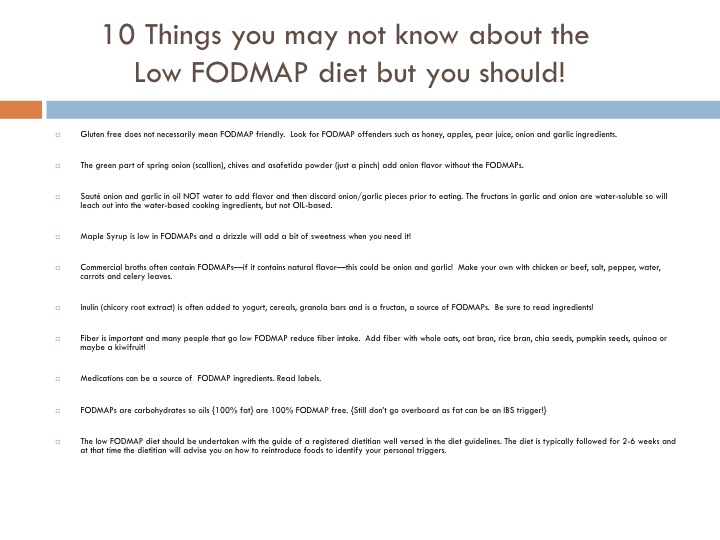

Nan
Hi Kate,
I have recently found the low FODMAPS diet and it has changed my life!!!!! Thank-you to Elise’s blog, and then I found you on line. I live in the Boston area and I would like to consult with you – is that possible? Can my physician write a referral? I could use some help navigating this new path….
katescarlata
It is a great diet approach that has helped so many people! Yes, you can consult with me. My office in Boston is in West Roxbury and the phone # is 617-469-4000. Hope I get to meet you!
Julia Gamble
Kate,
My physician gave me a FODMAP list yesterday. I definitely do have IBS. Can you give me a list of dieticians in MA, north of Boston. I live in Pepperell, MA and I work in Bedford, MA
Thank you,
Julia Gamble
katescarlata
Hi Julia,
Thanks for stopping by….I recommend Sophia Kamveris at eatrightboston http://www.eatrightboston.com/Eat_Right_Boston/FIRST.html
Kate
Sally
I have been following the fodmap plan for a week and first few days were great but now bloated again and constipated any advice….
Cat
I had the very same experience. Big improvement in bloating, pain and stool regularity, and then suddenly back to all the issues again.
Mavis Harvey
Can I eat pork sausage on a fodmap diet
katescarlata
Mavis, yes, I allow pork sausage if there are no other FODMAP ingredients such as onion or garlic.
Gail
Kate, I couldn’t find your email address…so i hope you see this email. I may be in denial, but I still am wondering if light soy milk by SILK or Whole Foods (365 brand) Is acceptable on a Low Foodmap diet–Thanks! Gail
katescarlata
Gail, if the silk milk contains whole soybean and I believe that to be the case in the 2 brands you mentioned–then it would likely contain FODMAPs. The only US brand that I know might fit the criteria is 8th Continent.
Zoe levitt
Hi Kate
My Dr. recently told me about the FOD diet and I just found your site! Thank you very much for taking the time to do this. I will spend the next week or so educating myself about this diet and I have happily subscribed to your blog. Your blog makes me feel supported in my effort to learn about a different way of eating. Anyhow I wanted to ask you if wheat berries are low FOD?
With thanks, Zoe
Adi
Can I eat white and brown rice and baked potatoes on fodmap??
katescarlata
Yes, brown, white and baked white potatoes are low FODMAP.
Helen
I am trying to follow the fodmap diet on my own but find I could benefit from the help of a dietician. Can you recommend someone in southeastern MA? I live in Lakeville and am handicapped so can not drive long distances.
Mary McCormick
Thank you so much for this site. I am beginning to follow this diet to the letter. Although I probably don’t have IBS I do have dyspepsia (4 months since onset) and after tons of gastro tests to rule out other diseases my doc has suggested I follow this diet. I am so glad you are keeping it updated. I have already found that enzymes do cause pain for me. I will also drop the probiotics and check labels more carefully on other items. Although I have some food science background I will also seek out the assistance of an R.D. if I can find one familiar with FODMAPS in my community. Again thank you. You are doing people a great service. Mary
katescarlata
Thank you Mary for your very kind words….always appreciated. 🙂
Mary
I am planning to start the FODMAP diet Monday. I live in Alaska and there are no dieticians here familiar with the diet. How critical is it to have a dietician? Do you know any one here who can help?
katescarlata
Hi Mary,
Because the diet has so many little “rules”, I do think it is best undertaken with the help of a registered dietitian. I do not have any contacts in Alaska, but perhaps you could contact the local hospital to see if their is an RD that is knowledgeable in the low FODMAP diet.
Mary
Thanks so much. I will try that. I appreciate what you are doing with this site and know its helpful to many.
Debbie French
I live in Vero Beach, Florida. Do you have anyone you can refer me to?
katescarlata
Debbie, My colleague Patsy Catsos has a registry of FODMAPs knowledgable RDs in the US–check out her site http://www.ibsfree.net
Kathleen
Hi Mary, I live in Alaska too and when my doc at ANMC sent an ANMC dietician to me ( my doc was also familiar with fodmap diet) he gave me the fodmap diet. I find it hard to believe that there is not a single RD familiar with fodmap diet here in Anchorage. Maybe you could call ANMC for further information…? I also bought The IBS Elimination Diet and Cookbook by Patsy Catsos, MS, RDN, LP for further info. There are many books on Amazon about FODMAPS diet and I just looked at the ratings and read comments and thus bought this book. Good luck!
kai loon
Hi kate, heard from some website brown rice flour/brown rice contain fructans which is unsafe.. So for items containing brown rice flour, are they safe for frucmals?
katescarlata
I look at the Australian research as the primary source of my information and when they analyzed brown rice it only had a trace of fructans so, I consider it as safe.
Stephanie
Hi Kate,
Question regarding beets. I noticed having a few slices are okay according to your list. What is your opinion on both juicing a beet and using one when making a vegetable stock?
Thanks!
katescarlata
Beet root has fructans and GOS if used in a stock they would leach into liquid and you would then consume them…if you added just a few slices as allowed that would be fine, same for juicing.
esther
I am confused about soy beans. I see it as a Fodmap but notice you use soy sauce in many recipes. What is the difference?
katescarlata
Soy sauce has minimal carbohydrates (fodmaps are carbs) whereas soy beans and soy flours would be more problematic and much more significant FODMAP sources.
Syl
Soy sauce typically has 5% to 8% carbohydrates according to the USDA database. I cannot tolerate it.
katescarlata
Soy sauce has 1 gram of carbohydrate per Tablespoon.
Carol Blum
How about the fodmap load of tofu, a soy product?
katescarlata
From what I understand, the processing of tofu from soybeans minimizes the fodmap content and the Monash team have put it in their low FODMAP shopping guide. In normal serving size it should be a low fodmap food.
Barbara Robbins
We already use Tamara, a wheat-free substitute, for my husband who is celiac. Seems like it would contain fewer carbs and be better tolerated?
Lisa Raphel
Hi,
In the March 14 post from Mary, she states she is dropping her probiotic. You are generally a proponent of probiotics that don’t contain FODMAPS, correct? Thank you. Lisa
katescarlata
I think most of us could benefit from a probiotic–but finding the right probiotic is not a one size fits all approach. Some of my clients seem to be better without one. Probiotic science is still in it’s infancy so we still have a lot to learn. For what’s it worth, I use a probiotic only when my symptoms of IBS get aggravated and very sporadically otherwise.
Leslie
I have really bad IBS. I’ve been taking yourbiology. At first I loved it. Then like two weeks I had to cut down to one a day and work my way back up to two a day though. Now I take it all the time. The constant aching I had in my stomach is gone. Hope this helps someone too.
esther
Are goat cheese, fresh mozzarella cheese or feta cheese low in lactose and therefore allowable on Fodmaps? I know that you list mozzarella (and feta) on your low fodmaps shopping list, but I don’t know if the mozzarella is the fresh kind or the hard kind. I would love to treat myself and my husband to some fresh mozzarella, tomato, basil, and olive oil, but I don’t know if I dare.
Also, I’m a bit confused about feta. It’s on your shopping list, but perhaps the amount should be limited for me. I had an omelet yesterday with 2 eggs, a dash of lactose free milk, 3 kalamata olives, diced, a small tomato, diced, and about a 1/3 cup of crumbled feta cheese, all sauteed in a small amount of butter and olive oil. All were fodmap friendly ingredients, yet I bloated. Not the huge kind of bloat that I can get; more like 4 months pregnant than 9 months pregnant! Any suggestions as to the ingredient that might be the culprit?
esther
Kate, in addition to my question above about fresh mozzarella and feta cheese and if they are high in lactose, is miso paste fodmaps friendly? Miso paste is fermented soy and is an ingredient in something kind of yummy that is sold at the local health food store that is OK re fodmaps on all other counts.
Thanks,
Esther
katescarlata
I believe Miso paste would contain FODMAPs.
Susan
So excited to find this website. Can you please let me know if you addressed esthers questions on cheeses posted on 8/14/12? I am very curious what the answers are. Thanks!
katescarlata
Hi Susan, I am sorry I tried to find the comment you were referring to and couldn’t find it. I can tell you that most cheeses are allowed on the low FODMAP diet except particularly wet cheeses that still contain a fair amount of the whey (cottage cheese, ricotta) When cheese is made the proteins curdle and rise to the top and the whey –which contains the lactose is drained off. Cheddar, Swiss, Parmesan, even feta and brie are okay. The very soft mozzarella is okay too. Parm, Swiss and Cheddar have virtually no lactose while some of the softer cheeses may have 1-2 grams. Many individuals can tolerate some lactose in their diet–say up to 4 grams per sitting–but that is very individual.
Susan
Thanks Kate for the very helpful info!! So, does this mean whey protein (as in the powder) is a no-no? REALLY appreciate your time.
katescarlata
Susan, Whey protein alone should be fine–as FODMAPs are carbohydrates not protein-but sometimes products labeled whey protein concentrate vs. whey protein isolate may have some lactose. I know…it’s a bit confusing.
katescarlata
If it is whey protein–if it is simply the protein should be low FODMAP.
Lorrice Gordon
Thank you so much for the info on cheese. This diet was recommended to me because of some intestinal surgery. I was already freaked out about going gluten free and lactose free. Knowing I can eat some cheese will make it so much easier! I found this blog so helpful.
Mike Gonzalez
Hi, I’m just starting out on a low FODMAP diet and about 50% of the websites I check say cottage cheese is OK while 50% of the others say it is high FODMAP. I honestly don’t care too much about cottage cheese because I have very rarely eaten it, but this creates an issue with me trusting the rest of the foods on the website lists. Is there an official list of high FODMAP foods to avoid so that I don’t have to keep guessing if what a website is telling me is correct or not?
Mike
katescarlata
Welcome to the gray area of FODMAPs. FODMAP content is very portion driven. The amounts and foods are still be defined. I will say, try not to get too micro with the diet. I think my checklists are a good go to. Having used them for years with patients–with good results–I think they work well. Other good resources–Monash U blog and app, Patsy Catsos’ site. The three of us keep things up to date. Some medical centers are out dated–and although a great resource for medical info–may not be for FODMAP info.
katescarlata
So to get more micro with your answer, a few tablespoons are likely low enough in lactose to be tolerated –but I tend to tell patient to avoid during the elimination diet in larger portions.
Diane Walker
Kate,
Thank you so much for the great information on your website and book. After 1 year of suffering from complications from food poisoning I am finally getting back on track following the FODMAP guidelines. Could you clarify for me about King Arthur Flour. This is the flour I have always bought (being born in VT!) It is on the shopping list for low FODMAP foods but wheat/flour in on the HIGH Fodmap food list. Any advice would be great.
Thank You
Diane
katescarlata
Yes the King Arthur flour on the list is the Gluten free multi-purpose variety.
Jennifer Green
Hi Kate,
Thank you for all your helpful information! I just stumbled upon this FODMAP diet while doing research on IBS and it makes sense. I would like to approach a new style of eating with the expertise of a dietitian but I am having a hard time finding someone in the western part of our state (MA). Could you recommend someone out here?
Thanks.
katescarlata
Here is a link to a registry with RDs knowledgable in the low FODMAP diet–from my colleague, Patsy Catsos’ site. I think the furtherest west is Worcester.
http://www.ibsfree.net/FODMAP-Friendly%20Dietitian%20Directory.pdf
Hope that might work for you.
lia
Hi. I am looking for a substitute for tomatoes that is fodmaps friendly. I used to make “no-mato” sauce from beets and carrots but i bloat even after removing the garlic from the recipe (replaced that with garlic infused EVOO). Also, are ground flax seeds safe? I make microwave gluten free muffins with Jorge Cruz’ recipe but am flying blind on flax.
katescarlata
Beets are one of those moderate/high FODMAP foods so they could still be causing you some symptoms in a sauce…can you make it with only small amount of beets and heavier on the carrots? The only data I have on flaxseed is in a mixture more commonly used in Austrailia called LSA (Linseed, Sunflower, Almond mix)– Linseeds are Flax. So in that mixture the cut off is 1 Tablespoon. So I think if you keep the serving of flax per serving –1 Tablespoon you should be okay. Hope that helps Lia.
olive
That’s the Austrialian Tablespoon (=4 US tsp)
Not the standard Tablespoon (=3 US tsp)
right?
katescarlata
Olive that would be correct and thank you for bringing that to my attention. One Australian Tablespoon is more than US–it’s like a Tablespoon + 1 teaspoon.
LA Rosen
This info on flax is very useful. We’re trying to get a bit more fiber back in the diet, but very carefully. Breakfast is usually rolled oats with small amount of safe fruits (bananas, blueberries, pineapple), a bit of nuts (pecans or walnut pieces) or a swirl of peanut butter or pumpkin; and lately we’ve added a tsp or two of freshly ground golden flax. Trying to monitor, but hard to know if whatever transpires through the day is from breakfast, or the lunch 2 hours later, or the mid-afternoon snack…. Trying to keep to just one new thing, or increased portion a day. We’ve also started trying very well rinsed quinoa (cooked in homemade broth) at dinner for added protein. Your site gives so much added useful info. Thank you for creating and monitoring this valuable resource.
Lindsay Willard
Hi! Can u recommend a dietician in So cal that is familiar with fodmap? My 7 year old has FM and ongoing SIBO. The dietitians at pedi hospital regurgitate info off the Internet and try and help but I need someone who can help us as my child refuses to eat and feels miserable- thank you so much! Maybe we could come to you? If you could help us I would seriously do it. Thanks, Lindsay Willard
katescarlata
Lindsay, Have they treated your daughter for the SIBO?
It’s hard to eat when you have SIBO–food often = pain.
I reached out to a colleague at UCLA med center–would that work for you?
Let me see what I can find out.
I occasionally do Skype or phone consults so if you can’t find someone close to your home–which is always best-then perhaps we could consider that route.
Best to you!
Lauren Harris
Hi! I have SIBO and I love my Dr. At Cedars Sinai. His name is Leo Treyzon. Very kind.
Good luck!
Ashlee
I was just diagnosed with IBS on Friday and told to follow a low FODMAP diet, can you send some recommendations as I do not eat beef or pork only chicken fish and shrimp, please help
katescarlata
Ashlee–Take a peek at my menu and snack suggestions–found on my blog at this link: http://blog.katescarlata.com/fodmaps-basics/fodmaps-menu-and-snacks/…You can sub chicken and fish in for beef recipes.
nicole
Hi is this dietgood for people with chrons disease? Thanks
katescarlata
Nicole, It can be helpful for those with Crohn’s disease. Particularly because individuals with Crohn’s are at higher risk for malabsorbing fructose. But, I would encourage you to seek assistance with the diet from a knowledgable dietitian.
Isabel
Hi Kate,
I’ve been experiencing IBS-like symptoms for the past 6-8 months (although not diagnosis has been made, many other things have been ruled out by lab tests).
Have decided to try this diet plan to see if I see any alleviation of symptoms (mostly a lot of bloating).
I’ve heard mixed things about sweet potatoes (concerns with mannitol). I’m disinclined to give them up because they’re a pretty big part of my diet. Any insight? I stick mostly to Japanese sweet potatoes.
katescarlata
Hi Isabel. Sweet potatoes are a source of mannitol and this is a sugar alcohol (Polyol source.) Mannitol malabsorption is less common than sorbitol so perhaps you will tolerate them just fine. Many of my clients have been able to tolerate other mannitol sources such as cauliflower and mushrooms.
If you could try to limit to 1/2 cup serving at a sitting–you will be under the mannitol limit–perhaps try that for the first 2 weeks of the elimination phase and then try to re-challenge your diet with the sweet potatoes at that time.
You could have 1/2 cup sweet potatoes 3 times per day –as long as you spread them out over the course of the day.
Linda Lee
Many yrs ago when all the autoimmune problems started for me, a GP told me most likely the bowel problems I was having were IBS. Not till recently when BLOATING AND PAIN became so prominent have I decided I NEED to really check this out…and my Living Without Magazine had that article about you and wala, FOUND your blog and such..ordered both your book and Patsy Catsos..am looking forward to learning a new way of eating to be painfree. THANKS for all you are doing!!
katescarlata
So glad you came by my blog Linda!! And I am so glad Living Without did a feature on FODMAPs–just wish more media outlets would talk FODMAPs! And glad you think Lucy is a adorable….she is cute and a HANDFUL!!
Cindy
Hi Kate,
I have been battling IBS for the past 8 years. I eliminated all dairy from my diet for five years, but continue to have symptoms. Just learned of the FodMap diet from a friend of a friend. As with most people, this is seriously effecting my life. Can you recommend a dietician who is in the Portland, Oregon area? Thank you!
katescarlata
Hi Cindy, my colleague Patsy Catsos has a dietitian registry on her site and I have attached the link here–>http://www.ibsfree.net/FODMAP-Friendly%20Dietitian%20Directory1.pdf
There is one RD I believe on the above link from Portland.
Discuss the possibility of small intestinal bacterial overgrowth with your physician too as I find many of my IBS patients suffer from this condition as well.
Nancy
I am new to this… Can someone explain why multi-purpose flour is on the list as a low fodmap??
Thanks!
katescarlata
Nancy-the multipurpose flour I believe you are referring to is the king arthur gluten free flour.
talli
I have a question about sugar made from beets. Is that okay or not okay on low FODMAPs? (I seem to have special intolerance, within FODMAP diet, for beets).
Also, what about beetroot fiber, which is in some gluten-free flours? I seemed to have a bad reaction after making a cake with that kind of flour. Could that be the culprit? (It also has tapioca, sarrasin (buckwheat), and carob). Thanks!
katescarlata
I believe beet fiber would be a FODMAP source. What I have seen about beet sugar–it appears that it would be okay and allowed BUT I have not seen actual Monash data on this –so use with caution.
Pete
I’ve just startet on a FODMAP diet and bought four different kinds (and brands) of gluten free breads for the occasion. They do however all contain sugar beet fiber. Your blog has the only mention I can find of beet fiber and FODMAPs. Do you (or anybody) know anything more about it?
Thank you!
katescarlata
Pete–not sure we know much about sugar beet fiber & FODMAPs. Would suggest you try Udi’s white sandwich bread –which at most recent check seems to be suitable….and has been well tolerated by my clients. The whole grain Udi’s seems like it might be okay–small amount of molasses but should might be okay. I have noticed that food manufacturers are adding sugar fibers and corn fibers–and I can’t say for sure that these would be suitable on the low FODMAP diet.
talli
Thanks, that’s helpful to know that beet fiber and beet sugar could act differently!
Another Q: I just saw a comment about flours and thickeners on low FODMAPS. It was about adding agar agar (derived from seaweed), and also grass jelly (cincau – a plant) powder as thickeners.
http://fodmapsdiet.com/2013/01/11/pancake-for-one/#comment-1651
Do you know if either of these foods are okay for low FODMAPS?
Elaine
Do you know whether Peppadew peppers are high in fodmaps? I suspect fructose? Thank you
katescarlata
Elaine, I have not seed data on Peppadew peppers-chile peppers and bell peppers are low FODMAP though.
Elaine
Ok I will give them a try, thank you. Anything to add flavour!
Claire
Thanks for the helpful blog, Kate. I’ve been on the low fodmap diet for a few years (through ShepherdWorks in Melbourne), and am thankful for the dramatic reduction in IBS pain. We’ve moved to Switzerland, and now have the challenge of reading ingredients in other languages! There are a number of products I find it difficult to buy here, e.g. debittered soy flour. Can you suggest a substitute?
katescarlata
I am not sure I would use soy flour due to FODMAP content anyway–I like buckwheat flour, brown rice flour, potato starch, oat flour as my favorite options.
Elizabet
Hi Kate. I was just doing some Googling for “buckwheat fodmap” and found this post. I love buckwheat flour for baking and I’ve read it has tremendous anti-cancer attributes. However, the Monash app lists only buckwheat kernels (which would then just be ground into flour), and it lists them as high FODMAP. Has there been an update to the status?
katescarlata
Elizabeth–I have not seen data on buckwheat flour—but may be different depending on the processing and the fiber content left in the flour product. Buckwheat kernels are limited to 1/4 cup–this would be the whole grain.
Heidi Peyser
I posted this just now but didn’t have the notify by email part checked. please respond to/approve this and not the other.
I’m on week one of the elimination phase and I keep having this odd experience where gluten free products that looks safe on the ingredients front immediately tingle going down. The only thing I can come up with so far is that they both were made with flours which are resistant starches.
I have found a lot of material suggesting that resistant starches act like the F in FODMAP.
Can you please comment on this?
katescarlata
Resistant starches are fermentable in the colon–so they can cause gas. They are made of longer chains of carbohydrates compared to FODMAP–so are not as likely to pull water into the intestine as FODMAPs do.
Tamara
Kate,
I live in San Bernardino, CA. Can you recommend a knowledgeable RD in the area.
katescarlata
Tamara-Check out my colleague, Patsy’s list of RDs that are knowledgable in the diet. Hopefully there is someone near you!! http://www.ibsfree.net/FODMAP-Friendly%20Dietitian%20Directory1.pdf
simon petkovic
hi kate,
a lot of useful info on this blog.had an illeosecal resectioning in 1998.doctors never established what exactly is causing my continued symptoms-diarrhea,bleeding,sore rectal area (proctitis?).have done a number of tests,colonoscopies etc etc bla bla.i seem to be sensitive to most foods prohibited on the fodmaps diet.also to fried foods,all cereals,all soy products-the list of foods are far greater than the list of foods i can tolerate.any suggestions on what to eat in order to cure/improve a sore rectum and fluctuating blood sugar levels (my villi seem to be not functioning properly after years of being aggravated by foods i shouldn’t have been eating)?also-how to get rid of ongoing diarhea and improve my bowel motions?and finally-a good r.d. to contact here in melbourne.thanx so much!
katescarlata
I would recommend you see a dietitian and gastroenterologist to help you work through your challenging symptoms.
You are lucky to be in Melbourne as this is the hub of all the amazing research in the world of FODMAPs. I believe Jaci Barrett is at diet solutions. http://dietsolutions.net.au
Kristin
Hi Kate,
I just found your site today while researching FODMAPS info. After years of gastro visits, testing and failures, I have figured out that I have a gluten intolerance, so have been avoiding that for 3 years already. I normally eat a very vegetable/fruit/protein/dairy diet, but have recently started a Whole30 (sort of Paleo) that also restricts sugar and dairy. Since starting it, and obviously eating more protein and vegetables than normal, my stomach is very distended and feels full all the time, exactly like when I eat gluten. I have always wondered about onions (they give me a headache when cooking them, so I’m thinking my body is telling me they’re not what it wants) and sometimes garlic is offending as well. I live in Hopkinton, Ma and would love to get involved with someone that is familiar with these kinds of issues. Are you local (I saw Boston) or can you recommend someone else that might be? Thanks, Kristin
katescarlata
Kristin, I have an office in Medway so if you’d like an appointment just call my office 508-533-0800.
Michele
Hi Kate
Great blog. I am based in Sydney Australia any recommendations for RD here . Thx
katescarlata
Hi Michele, I don’t have a specific recommendations for a dietitian in Sydney…but I am sure there are many FODMAPs knowledgable dietitians there. Perhaps reach out to Catherine Saxelby she is near Sydney and may be able to help you! http://foodwatch.com.au/about.html
Michele
Thx Kate
I have down loaded the monash PODMAP app for my iPhone and so far it is proving very user friendly…
Michele
katescarlata
Oh yes, Michelle, the Monash University low FODMAP diet app is very user friendly and such a great tool for patients and health care professionals alike. I am so grateful that the Melbourne, Australian researchers put it together.
Kristen
Hi Kate,
My 6 year old has had an ongoing issue with constipation and GERD. He has been treated for both but without a lot of success. Recently he was tested and found to have Bacterial Overgrowth Syndrome. He is now on his second round of flagyl but experiencing a lot of nausea and gas. His GI suggested the Fodmap diet. I noticed he eats some of these foods in large amounts (Watermelon, milk, pasta, apples, cheese). Do you think just elimating the foods he eats a lot of would give him some releif or do you think all food listed should be avoided? Thanks for all the wonderful information.
Kristen
Kristen
Also wanted to mention that he has peanut, tree nut and egg allergies.
katescarlata
Kristen, I would encourage you to work with a dietitian. It wouldn’t be prudent to advise you via the blog on what’s best for you son without understanding his normal intake, nutritional needs, past medical history etc…and this is done thoroughly with a dietitian. That being said…I find it’s best in most circumstances to do a complete elimination diet for 2 weeks to get a better understanding of what foods are problematic. Certainly in the elderly,malnourished and pediatric population, for example, the full elimination diet may be too restrictive and I would opt for a more liberal approach and simply limit the foods most often consumed with the highest amount of FODMAPs. Hope that helps. Of note, ensuring adequate fiber in those with IBS-C (constipation) is key from my experience. Here is a little info on low FODMAP choices and fiber content: http://blog.katescarlata.com/fodmaps-basics/fiber-without-fodmaps/ Also, chia seeds are a great source. 1 TB has 5 grams of fiber!
Missy
I have been an IBS sufferer for along time now, and find its very debilitating. I am also Lactose Intolerant. I have just found out about FODMAP. Which meats should I avoid? Are there any types of FODMAP friendly, lactose free milk brands available that I can use in recipes. I am finding this transition very difficult and know that I must stick to it in order to get my life back. Can you recommend any books/recipe books?
Thank you.
katescarlata
Hi Missy, FODMAPs are carbohydrates and meats are carb free so all meats are allowed…unless of course, prepared with FODMAP containing ingredients such as honey ham for instance–honey is a FODMAP. Lactose free yogurt such as Green valley is well tolerated. Lactaid milk and lactaid cottage cheese should be okay too. For review of the elimination phase of the diet, IBS Free by Patsy Catsos is a great book and for recipes I have plenty on this blog but also in my low FODMAP downloadable cookbook link here: http://www.katescarlata.com/fodmap.htm
Missy
Thank you for the quick response. This is very mind boggling and stressful.
Would Almond milk be ok?
katescarlata
Almond milk is being tested now.
Not sure if it will be suitable as many of my clients can not tolerated.
Louise
Still in diagnosis stage but GI reccommended FODMAP diet. Can you tell me if Mirin would be tolerated on diet? Also Splenda? What about roasted garlic? My tests came back negative for Seliacs and lactose intolerance. Have yet to take fructose test, CT entrorography and endoscopy but main symptoms are diarrhea. Some bloating. It sounds like the people with IBS have more problems with bloating. Also colonoscopy did not show any abnormalities.
katescarlata
Louise,
My guess is that Mirin as a sweet wine would not be low FODMAP. I am not a fan of splenda but it should not be a FODMAP. There was one study that suggested it reduced beneficial gut bacteria. Fake foods for all of us, should be kept at a minimum, right? The low FODMAP diet is very helpful in the management of diarrhea so hopefully it will help you out.
Louise
Thank you for the information. I am trying to navigate a lot of information. I just finished a six week low residue fiber diet and so many foods I could not eat on that diet are allowed on FODMAP and vise versa and it is all so confusing. BTW- the low fiber diet did not help at all. So the allowable sweeteners on this diet are maple syrup and sugar. Is that right?
John
I am just about to begin this diet I was diagoised with IBS and have massive bloating when I eat so I am hoping this will help relieve some of my symoptoms. I live near the Washington DC area and was hoping you could refer a great dietician I could speak with.
Thanks.
katescarlata
Yes, John my colleague Rebecca is wonderful! http://rebeccascritchfield.com
talli
Hi,
For some reason my Q from Feb 15 was not answered. And I’d love to know if you have any wisdom.
It’s a Q about substances often used in desserts or as thickeners. Is agar agar (derived from seaweed), or also grass jelly (cincau – a plant) powder allowable? I saw this (unanswered post) about the subject here:
http://fodmapsdiet.com/2013/01/11/pancake-for-one/#comment-1651
Do you know if either of these foods are okay for low FODMAPS? Thanks!
katescarlata
Talli, I have not seen any data on those substances sorry.
Carol Anheier
Several years ago my Gastroenterologist diagnosed me with Chrons and six months ago said he made a mistake and that I had IBS. Well, I have had IBS for many years and a year ago was tested for food intolerance. Results showed that I am Gluten intolerant, casein, lactose, egg yolks coffee and many other foods. Fatty greasy foods also make me sick. Walking outside for exercise is impossible and I dislike mall walking. I love to travel and that has also become very difficult. I first saw FodMap mentioned in Living Without Magazine and am very excited about finally having something to help me. I live in Wisconsin and need to find a diatician who can help me. The Gastroenterologist has been no help. Do you know of anyone in the Appleton, Green Bay, Madison area? In September we have a Pilgrimage scheduled to France and I would like to have this under control before then.
katescarlata
Carol-Check out the site ibsfree.net and look for ‘fodmap-friendly’ dietitian list. You may find a Wisconsin dietitian listed. Good luck!
Louise
Hi Kate,
I just ordered your book and one other on IBS. my doctor has not given me a diagnosis yet, but I took the fructose test this week and my hydrogen level was four times higher than normal range. I am now looking at information on fructose malabsorption information. I did not test high for lactose intolerance. Would you still recommend the strict FODMAT diet? I checked for a dietician in NM on the web site and there are none listed. Louise
katescarlata
Louise, be sure to be tested for small intestinal bacterial overgrowth which often goes hand and hand with fructose malabsorption(FM). Typically, yes, the diet for FM would be a low FODMAP diet for 2-6 weeks followed by the re-challenge phase to evaluate which FODMAPs trigger symptoms.
Louise Broadbent
Kate, Thank you so much for your help. When I return from my trip I will ask my GI about the test for small intestine bacterial overgrowth. I had been scheduled for a CT entorography (sp?) and cancelled. I hope that was not the test for bacterial growth. I just wanted to make sure I was not doing a lot of unnecessary tests. The nurse from my GI said they were requesting a referral for a dietician. I feel I am on the way to better days. Thanks again. Louise
katescarlata
Hi Louise, the small intestinal bacterial overgrowth test is typically a breath test. So happy to hear you will be working with a dietitian. Good luck and YES…on your way to better days!
Signe
Hi Kate
can you tell me if I can eat Misosoup as part of a low fodmap diet? The ingredient I am most uncertain about is soybeans.
Thanks so much in advance
katescarlata
Signe, I don’t believe miso soup would be a good choice on the low FODMAP diet.
sandra tassel
Hello Kate,
Your blog, cookbook and shopping list are true Godsends for me and my husband, who is suffering from something ever since he took a round of Cipro in December after contracting an intestinal bacteria when we were in Panama. The Gastroenterologist ordered all the tests she could think of but really wanted to go for the colonoscopy. When he resisted she mentioned trying a low FODMAP diet. It helped almost from day one. We are adjusting reasonably well because there are so many decent foods in our local co-op and I like to cook. Turns out giving up soft cheese has been difficult though. What is the rule on goat and sheep products? I know they have different proteins…
Thank you!
Sandy
katescarlata
Hi Sandy, It’s true, the casein in goat milk products is easier to digest for some…but this is not a FODMAP relationship–as FODMAPs are carbohydrates. Goat and sheep milk would not be allowed due to the lactose content BUT cheeses made with goat or sheep milk should be okay as long as they are not too ‘wet’ meaning that some of the lactose was retained in the cheese. It the cheese is creamy–small amounts such as a couple tablespoon crumbled on a salad should be low enough in lactose.
Mari
Hello Kate… my husband returned from the doctor today and she suggested he start following the low Fodmap diet. He suffers a lot from the issues that you discuss: IBS. As a newbie [as of today], what do you suggest I do first? I plan on contacting a dietician in my area [SF bay area CA] but what else should I do while we wait? Any advice would be greatly appreciated! I’m off to read more from your website! Thank you… Mari
katescarlata
Mari First be sure you husband has been screened for celiac disease. It’s always important before you take wheat out of the diet -even for the short term-that he be tested for celiac which can have some overlapping symptoms with IBS. Celiac testing is inaccurate without wheat in the diet. Patsy Catsos’ book, IBS free at last is a great reference when starting the diet. And of course, work with a (FOdMAP knowledgeable) dietitian to ensure your husband is doing the diet correctly and with healthily.
Susanne W.
AFter trying 4 rounds of different antibiotics, the FODMAPS immediately took care of my IBS. Now I need to figure out how to put foods back in. Any dieticians recommended in the Philadelphia and surrounding suburban areas?
katescarlata
Try Sharon Howard but I am not sure how close she is to Phili.
sharon.howard.rd@gmail.com
Laurie R.
My doctor recommended the low FODMAP diet plan today to me. Can you recommend a dietician in the Fort Myers, FL area? Thank you!
katescarlata
Is Palm Beach Gardens close enough? Here is an RD Sandy that may be able to help you. www. palmbeachnutritionist.com
Sabrina
This website is AWESOME! I am day 20 on my Whole30 challenge and recently discovered the low FODMAP diet. I initially started Whole30 to ease my IBS troubles, and so far my stomach actually feels worse =(. I did some research and found out about FODMAP and the whole shebang behind it. I have the bloaty, gassy, gurgly, dread eating kind of IBS and I am sick sick sick of it. Whole30 has it’s benefits ( I do sleep a whole lot better) but I am still having issues with my stomach. As soon as I am done with Whole30 I plan on committing to the FODMAP elimination diet to see if it helps. Unfortunately I can’t find any local Houston, TX dietitians who specialize in FODMAP so I figured maybe someone on here can help me out. Any pointers, advice, resources, support would be GREATLY appreciated! I also have a food journal/blog and document everything I eat on: whole30fortheworkingirl@blogspot.com, if you check it out maybe you can give me some pointers as to what I’m doing wrong?
Sarah
I am very new to the low FODMAP diet and am trying to figure it out. I have Celiac Disease that is well controlled and already know that I do not tolerate hardly any grains at all. I am wondering if dried (unsweetened) coconut is allowed. What about unsweetened coconut milk? Thanks.
katescarlata
Yes, dried coconut and unsweetened coconut milk are allowed on the low FODMAP diet, Sarah.
STEVE
I’ve just been told about the Lowfodmap diet and am trying to work out what foods I can eat.This site is very enlightening because the questions are often those I had not thought to ask.
Great site,thanks
Pat Skinner
Hi Kate, My husband has cholangiocarcinoma and watery diarrhea usually after eating. The doctors say the secretory diarrhea is caused by the chemo and he has lots of meds for it, but it is an ongoing problem. I am trying the fodmap plan because he eats lots of carbs due to taste changes. Do you have any suggestions that might be helpful?
katescarlata
Hi Pat, I wonder if it might be possible to meet with a dietitian in your area that specializes in digestive health. It seems to me that your husband would benefit from a nutrition evaluation and take into account his medical history to find a nourishing, tasty and easy to digest diet for his health condition.
lynn cardy
I have just discovered your website and think it’s truly enlightening. I live in London UK and am looking for a nutritionist/dietician who is really conversant with the FODMAP diet. Finding that a bit tricky so wondered if you had met with any while doing your own research?
Thanks so much
katescarlata
Lynn- Kings College London runs a FODMAP course for dietitians. I have reached out to Emma Carder who practices in the UK and is very knowledgable in FODMAPs to see if there is a list of dietitians that have taken this course. Stay tuned.
amy
Hi, after 2 years of stomach pain for my 6 year old, I just discovered this list and have already found that the things with high FODMAPs are exactly what make him sick and in pain on the couch for hours. The only time he felt ok in the past 2 years was when I gave him a broad spectrum digestive enzyme before each meal. ( I did this for 3 weeks). So, I know he needs to follow this diet. My question is- why can he not eat things on this list? I know IBS is one reason…what are some other reasons. I want to get to the bottom of WHY he cannot eat these foods with out the help of a digestive enzyme. He saw a GI dr for the first time yesterday…she thinks he is constipated..sigh..( even though he pooped 19 times last week) she obviously has no clue.
katescarlata
Hi Amy, first be sure your son is tested for celiac disease. This can be done with a blood test for an initial screening. It’s important before you remove wheat from the diet to test for celiac because the testing is not accurate once wheat, barley and rye (the gluten containing sources in the diet) are removed on the low FODMAP diet. People are sensitive to FODMAPs if they don’t absorb them well. This could be due to small intestinal bacterial overgrowth–the bacteria creep into the small intestine and break down the FODMAPs before they have the opportunity to be digested. Some FODMAPs are not digested by the human body: Fructans and GOS so are often culprit for GI symptoms. Lack of digestive enzymes such as lactase can make lactose, the sugar in milk products non absorbable and thus become food for bacteria. When intestinal bacteria consume FODMAPs they produce gas. In individuals with IBS –a motility disorder—the gas can become trapped causing pain or the gas can be created in the small intestine which has a narrow diameter and so the stretching of the intestine might contribute to pain as well. The doctor may feel stool in his intestine which she is relating to constipation. Many IBSers don’t empty the intestines completely which also plays a role in their symptoms. The gases produced by consumption of FODMAPs by bacteria can play a role in slowing down the intestine (methane producing microbes are linked with this) or sped up by hydrogen gas producing microbes (gut bacteria). It’s complicated biology in the gut!!
Jade
Hi Kate,
I have started to reintroduce FODMAP’s.
I want to sample onion next but wondered if you had any ideas as to what Type of onion would be best to try and maybe what Amount, if that’s important too….ohhh and Cooked or Raw!?
I am pretty excited about this test as along with garlic, something I used to eat a lot off.
Any help very appreciated!!
Jade….’almost out of the woods!’
katescarlata
Hey Jade…Onion seems to be a very hard challenge to pass for many of my clients. I have not seen data on different types of onion so I would try the onion you most enjoy. Stick with small amount cooked or raw, though some find cooked better tolerated–the test amount is 1 Tablespoon. I can enjoy traces of onion in foods such as salad dressing but not big chunks in foods–but everyone is a bit different. Best of luck to you!
Jade
Oh blimey, this could be the most challenging challenge yet….
Thanku very much…. I’m going to go for 1 tablespoon cooked! :-/
amy
Hi, my 6 year old has been gluten and dairy free for 7 months. He was doing so much better, but now he is sick all the time again. I have found that he NEEDS to be eating low FODMAP foods in order to feel well. I am so glad I found this site! But, I have a question, he is going to be tested for celiac. Do you know of a low FODMAP food I could give him that does contain gluten? I know Cheerios are FODMAP friendly, but are not gluten free.Any other suggestions for what I can give him? He has to be eating gluten daily for 12 weeks in order to do the biopsy to check for Celiac disease. I want to keep him as low FODMAP as possible to reduce his pain, but he needs to be eating gluten! thanks so much.
katescarlata
Amy, I would encourage you to ask his doctor but a few low FODMAP foods with gluten would be 100% spelt bread (whole foods has a brand, French meadows), soy sauce, seitan (gluten rich vegan protein source), small amounts of wheat pretzels might be okay too–try 1/4 cup regular pretzels as a snack (Monash allows these on their app), you might also try sourdough white bread (many of my clients can tolerate it when we do a wheat challenge) or Bay’s English muffins which are a white wheat based English muffins, in the refrigerator section of the grocery store that many of my clients can tolerate too when we do the wheat challenge.
Louis
Hi Kate, many thanks for creating such a great online resource. I’ve just started the FODMAP diet this week, I’m a vegetarian, and it is tough. But the improvements I’m feeling already more than make up for it, or though I was heart broken when I discovered I couldn’t drink camomile tea 🙂 One thing I found on another site detailed do’s and don’ts for vegetarians and one of them is –
‘Don’t: Stay on the elimination phase for more than two weeks. You need to liberalize your diet sooner than meat-eaters in order to get adequate nutrients.’
http://www.ibsfree.net/ibsfree_at_last/extras/
Would you agree with this? Or is it safe for a vegetarian to continue the elimination phase for 6-8 weeks? Any advice would be most appreciated.
katescarlata
If you follow the diet and include tofu, tempeh, and small amounts of allowed legumes: 1/4 cup canned chick peas and 1/2 cup canned lentils I think you might be okay to stay on it a bit longer BUT…once your symptoms are managed–and that may only take 2 weeks–you should start the re-introduction/challenge phase. It also depends on if you include eggs, cheese and lactose free milk which would allow for greater variety and nutrients.
Louis
That’s good to hear, many thanks. I didn’t realize I could eat some chickpeas, that’s made my day! When you say ‘once your symptoms are managed’ do you mean completely IBS free? My first few days with the diet saw a huge improvement but now in the second week the IBS has come creeping back. The only foods that don’t cause any symptoms are rice, eggs and potatoes, which is obviously a very limited diet 🙂
Jade
Hi Kate,
Well it’s been a time since I started my FODMAP experience but with the help of your recipe booklet, within days, I was happy to discover that I was on the right track! Finding FODMAP saved me where nothing else would.
I have come to share my re challenge! results…..
Honey – symptoms returned 2 days with nausea.
Wheat – symptoms returned with nausea and stayed for 5 days.
Garlic – 1 whole clove fine (haven’t tried more yet).
Onions – symptoms back for 2 days – no nausea but bloated.
Lactose – (I was already lacto intolerant)
And a question regarding…..
You made an interesting point before that the difference between SIBO being present and Fructose malabsorption is sometimes clear when the FODMAP foods are brought back.
I have since been interested as to what this meant and how SIBO would show itself.
I was really interested in what you thought of my results. My thinking is that my ‘suffering’ would have been a lot worse if it was SIBO.
(I did have a breathe test for SIBO and it was negative, showing both low levels of Methane and Hydrogen.)
However just in case the results where inaccurate….I am all ears as to what you think….Are my results typical of a food problem rather than SIBO?
BTW – I should say to anyone reading FODMAP has helped me 10 fold.
I haven’t had a chance to scoot around the whole website in a while because I have had my head in the fridge most days :D…..but looking forward to trying the banana, cinnamon, coconut recipe!
I hope the world of food is treating you kindly…..
Jade x
katescarlata
Hey Jade! So happy that you found the recipe booklet helpful! Yay! Not sure about sibo –but seems like you had symptoms but not terrible symptoms–is that correct? You might try a sourdough white bread–many of my clients have found that works for them. I personally wouldn’t push the garlic—I mean who needs more than a clove anyway? Sounds like you passed that one! Onions are tough for most people so no surprise there.
Jade
Hi Kate,
Yes the booklet really helped, gave me a structure!…
I will give sourdough a try, thank you… I forgot about this one.
Talk about having to learn about an area with no choice in the matter but worth it.
Jade – Happy tums to everyone 🙂
Ronney O'Donnell
Thank you so much for your informative and very helpful website. Is there a problem with the alcohol content of pure vanilla extract and a low fodmap diet?
katescarlata
The Monash researchers have allowed vanilla in their recipes so I allow it as well. I am not sure they have analyzed vanilla extract. I think the small amount of alcohol should be okay for most people.
Jade
Hi Kate and fellow FM peeps,
How is this possible…I ate 170g of kidney beans lastnight (in a chilli con carne) and had no symptoms?
Yet I failed the onion and wheat test?
🙂
katescarlata
Perhaps your gut bacteria enjoy the FODMAPs (fructans) better than GOS. 🙂
Jade
I just realized that they aren’t the same as fructans, really deceiving on the Monash app for your phone they class them all in the same category…think they should have a separate ‘class’ for the galactoligos.
Thanks
Gail Tauber
I need a NYC dietician–any to recommend?
Also anything you recommend for nausea associated with iBS/Dyspepsia?
Thank you thank you thank you.
katescarlata
Gail, Sometimes seeping a small piece of ginger root in hot water and making a tea to sip can easy nausea. Have you had a gastric motility test to rule out delayed stomach emptying?
NYC based RD I recommend is Tamara–http://www.tamaraduker.com
Gail Tauber
Thank you. I had so much ginger and ginger teas that I got sick of it. But I will get back to it.
I’m supposed to have a gastric motility test soon.
And thank you for the recommendation. I will contact Tamara.
Best,Gail
katescarlata
If you are sick of ginger tea…maybe even hot water with a slice of lemon. The warm water can help your stomach empty too.
Jade
Hi there Kate,
I’ve noticed a link on google to your website mentioning apple cider vinegar but cannot find the page. So you may have already written about this somewhere…anyway.
Is Apple cider vinegar a fodmap? or ok to have?
Many cheers
Jade
Hi Kate,
I’m so sorry …another question ahh.
I’m looking at a ton of probiotics at the moment. (I had constipation type ibs before I went low fodmap.)
Could you please suggest a good probiotic? (im lactose & fm intolerant).
Trying to heal my gut 🙁 for good.
katescarlata
Probiotic choice should be based on research. Typically I do this by looking at what symptoms the patient is experiencing and what probiotic has a proven track record (research based) for that symptom. Align and culturelle (without inulin) are often chosen by my clients. Often its a trial and error approach because we all have a unique gut bacteria ‘fingerprint’. There are other probiotics supplements that may work–here is a good overview on probiotics. http://www.worldgastroenterology.org/assets/export/userfiles/Probiotics_FINAL_20111128.pdf
Jade
That’s interesting & thank you so much..will investigate further.
Phyllis
My gastroenterologist put me on a low residue, gluten and lactose free diet for IBS, SIBA, and diverticulosis. My RD suggested the FODMAP diet and it has really helped.However, no raw fruits or vegetables(per my dr) is extremely restrictive. May I gradually add them to my diet? I have stage 4 breast cancer with bone metastases so am worried about proper nutrition.
katescarlata
Phyllis, I can not provide individual dietary guidelines in a blog format. I would advise you to discuss your concerns with the health care team that is working with you.
Best to you! And I am glad you feel better….
Shay
Hi I was wondering if agar-agar (kanten) is low or high in fodmaps? Thanks
Ashley Chase
do you make your own chicken broth? if so, do u have an easy recipe for this?
Well Balanced - Food - Life - Travel
I make my own chicken broth and not sure I have officially posted a recipe! Let me work on that one! I vary up my recipe but this is one variety: I add water to a large stock pot (about 8-10 cups),1-2 bone in chicken breast (about 1/2 pound each) some parsley, carrots, a celery stick, small lemon, peppercorns, a few scallion slices (green only), thyme and salt. Let it boil for 5 minutes and then simmer for about 30 minutes on medium-low heat. Turn off heat to and let the chicken slow cook for another hour and then strain broth-be careful it will still be warm. Use chicken to make chicken salad or other dish that suits you.
Janet
After suffering stomach pain, horrible gas, bloating, etc for two years, and undergoing every possible test the GI Dr could come up with at least once, most of them twice, I had a “medical assistant” suggest that I follow the FODMAP diet, by googling it. I did so (carefully) for 2 months, never adding dairy, and felt SOOO much better. So, I assume I have IBS. When the end of my 2 months came, I added only white bread/flour (1 serving on an occasional day), and nothing else. Then after several weeks of eating almost the same thing every day (not adding anything), I started getting the symptoms back again. I don’t have a dietician to help me, so I’m lost as to what to do next. It’s not only the days that I eat white flour, it’s every day, some days worse than others. Do I go back to wheat-free? Or where can I get the help I need? It was so nice to be symptom-free with my weight steady. Then I suddenly gained 3 lbs in one week…I guess from the bloating. Help!
Well Balanced - Food - Life - Travel
Janet, You could use the help of a dietitian that specializes in digestive health and nutrition. Can you try to find one in your local area? Where do you live? I can try to find you someone. Have you been tested for small intestinal bacterial overgrowth?
Carolyn
Hello Kate, I’ a huge fan of your website and follow a Fodmaps diet. Can’t find out anything about pumpkin though. Is it ok or hasn’t it been tested.
Thanks again,
Carolyn Harmer
Well Balanced - Food - Life - Travel
Carolyn, US pumpkin is undergoing testing. In the Australian info, ‘pumpkin’ often refers to what we would call in the US squash….so I sent them 4 cans of US pumpkin. I hope to learn soon if it is okay.
Carolyn
Thanks, Kate
Linda
Hello Kate, I think I wrote this before but don’t think it posted. I was wondering if pickles (if bought from a farmer’s market so they are homemade with no added sugar or garlic) are low FODMAP? Thanks for whatever guidance you can provide, Linda
Well Balanced - Food - Life - Travel
Linda, I believe I responded to this–yes pickles without onion/garlic should be suitable.
Shari
Hi Kate,
Absolutely love your website and blog, thank you!! My husband has been following the low FODMAP diet for 6 weeks now and feels so much better. We are waiting for our RD appointment set up by his gastroenterologist which is still 1 month away but he would like to start reintroducing some foods now. Wondering if you could suggest any foods that would be preferable to reintroduce first? I would like to choose wheat since that is one that would make cooking and eating a whole lot easier. Your thoughts?
Thank you
katescarlata
Thanks Shari–glad you like my blog 🙂 I typically don’t start with wheat first–but you could if you are truly missing it. I would start a ‘gentle’ wheat challenge by adding 1 slice of white sourdough bread while maintaining otherwise a low FODMAP diet. Then, if no symptoms–up to 2 slices of white sourdough bread on day #2. I encourage my clients to purchase a sourdough bread at Whole Foods or one with limited ingredients– only FODMAP friendly ingredients (besides the wheat). If on day 3–no symptoms he could try 3 slices at a sitting. Other wheat challenges that you could try Day #1 1/2 cup cooked pasta Day#2 1 cup cooked pasta Day#3 1 1/2 cup cooked pasta Wheat prepared with sourdough culture or white varieties seems easiest to re-introduce from my experience. Weight of bread can play a role too–if you eat a ‘heavy’ or dense roll for instance–by weight you would be eating more fructans–so opting for a light and airy bread may be better tolerated. Make sense?
Judy
I had rectal cancer surgery a year ago. The cancer was all removed as was a portion of my rectum. I have had bowel issues constipation and the loose stools since then. My doctor suggested trying a low FODMAP diet. Do you know of anyone else who has tried this with success? Thank You.
katescarlata
Hi Judy, Yes, I have has excellent luck with colon surgery patients and the low FODMAP diet. My major caution is that the low FODMAP diet lowers bifida bacteria populations which are linked with decreasing colon cancer risk–so the diet should be used short term–with the goal to try to get some of the fructans/GOS foods that increase these healthy gut bacteria population back into the diet.
Katie
I am having a hard time finding info on if balsalmic vinegar is low FODMAP. Can you assist me with this info?
katescarlata
Katie, interestingly, I don’t tolerate balsamic vinegar at all–but per Monash app 1 tablespoon is allowable.
Fleur
Hi Kate,
Just have a question about making your own stock. If I use celery to make it but strain it would this be ok? I have seen other recipes that only use the leaves so I thought maybe the polyols might be water soluble and therefore not ok?
katescarlata
I think if you limit to small amount of celery it should be okay. 1/4 stalk–chopped.
tamara
Hi Kate,
I like to eat winter squash, but it can be hard for me to digest. Is acorn squash, spaghetti squash, and kobacha squash low FODMAP. Also what do you think about taking digestive enzymes?
Thanks
katescarlata
Tamara–butternut squash has a fair amount of FODMAPs–both mannitol and GOS so needs to be limited to 1/4 cup, diced or less! not too much!
I have not seen data on the other squashes. I think digestive enzymes are appropriate for some individuals who may actually be deficient in enzyme production–I don’t believe everyone w/ digestive health gets benefit from taking them.
tamara
Kate,
Where and how can I be tested for SIBO?
katescarlata
SIBO testing is typically done in a hospital setting–big city hospital–not typically in the suburbs. But that seems to be changing as more hospitals are acquiring testing equipment. It might be done in a Gastroenterology Motility Lab or Department–if there is one. There are also home breath kits that you can use –but your health care provider would order it for you. Commonwealth labs is a Massachusetts based company- their test kits have been validated to some degree by Mark Pimentel–he compared results from Comm Lab kits vs. his equipment. http://hydrogenbreathtesting.com
S
Hi Kate,
Just wondering if tahini is considered low fodmap? Some resources say no others say yes but i’m confused because sesame seeds are considered low FODMAP so surely something that is made from 100% sesame seeds should also be low FODMAP?
Also, what do you think of this article? http://www.npr.org/blogs/thesalt/2014/04/28/306544406/got-gas-it-could-mean-you-ve-got-healthy-gut-microbes
There is increasing evidence that foods high in FODMAPs actually prevent IBS symptoms rather than promote it by creating healthy bacteria necessary to digest these FODMAPs.
Finally, is the Monash book more comprehensive than the iPhone application do you know? I find that the application is SO limited. For example, where would Barley Grass fall?
Many thanks!
Em
Hi Kate,
can you please advise on re-introduction of fodmaps where the main problem is constipation (followed by a day of frequency). Its hard to tell if the first sample of tested food has caused “symptoms” because of the time factor involved in constipation! So I never get past day one and learn nothing! Of course there is bloating too but again I am never sure how long after eating the “culprit” this would be expected to occur! I would so appreciate some guidance on these time factors, many thanks
katescarlata
How I do it: The test food should be added back once a day for three days. Get back to your baseline b/4 challenging a new food. Typically GI effects would be felt sometime during the day (w/ in 3-4 hours) of trialling –but constipation predominant patients are sometimes harder to read–and symptoms can take a bit longer.
Alex
I know beetroot is out but if something is made with beetroot powder for color is that out too or is there not enough to make a difference?
Linda
Hi, I just started the diet 2 days ago and I am learning to cook differently. Is coffee ok to drink and how about black teas like earl grey? Thanks. Linda
katescarlata
Coffee seems okay for most of my clients and is allowed in reasonable portion (1-2 cups). Black teas seem well tolerated too. Note that caffeine can stimulate the intestine to move–so adjust to your personal needs.
Linda
Thanks. I don’t seem to have a problem with it but I was wondering.
Sue
Hi,
Are popcorn (homemade), soy sauce and corn syrup as a sweetener in food (not partially hydrogenated) allowed on the FODMAP diet? My 18-year-old son just started it and is already getting frustrated about the lack of snack options.
Thanks so much
katescarlata
Sue, I allow popcorn but have not seen actual data on it. I know it has been included in some of Sue Shepherd’s books. Soy sauce is okay and as far as we know corn syrup is okay BUT not high fructose corn syrup.
Sue
Got it. HF corn syrup is evil. We cut it out of our diet years ago and my adult acne completely cleared. We live in the Boston area and my son is headed to BU in the fall, so we may contact you for an appt. Thanks so much for your quick reply.
Erin G
Wow! You are remarkable! I have suffered with digestive issues since I was a teenager. Now, 17 years later I’m starting to make sense of it all. I am confused on bananas, though! How do I tell–from looking at the green/yellow exterior–when the banana is the safest to eat? How many are safe in a day? The online data is confusing and Monash calls them by two separate names. Something like sweet banana and common?
Thanks again–You’re a Digestive Genius!
katescarlata
In the US, the banana in the app would refer to common banana. Ripe or unripe would be suitable on low FODMAP diet. Unripe has more starch and that can lead to gas in some people–depending on the nature and location of gut bacteria.
Sue
Hi again, Kate,
My son’s SIBO test was inconclusive, but he started with a high hydrogen baseline and had pain after the test, so the GI prescribed Xifaxan (Pimentel protocol dosage). He’s been on a strict FODMAP diet for almost two weeks with mild improvement. As per Pimentel (from your blog!), I know he should cut down on that while on the antibiotic. But how much? Eat completely normally? Just add a few wheat products or onions?
I hope you can advise as we have to wait a bit to see a nutritionist in person.
katescarlata
Hi Sue, I have not seen a definitive protocol…for liberalizing the diet. I tend to have my clients add small amounts of FODMAPs–1/2 an apple and some garlic and/or wheat to their day — I don’t want to fully exacerbate their symptoms but do want to have some ‘food’ for the microbes. More research is needed in this area!!
Sue
Thanks so much. I know there are two big RD practices in RI. Do you recommend anyone specific for this situation?
katescarlata
I know the RDs at this location are FODMAP savvy…http://www.evolutionrd.com/Locations.html If you make an appointment ask for the dietitian that does the most FODMAP consults.
Sue
Thank you – you’re so generous with your time. You may be seeing my son in the fall, though I hope he’s better by then.
christine gee
Hi…I have just come across this website whilst trying to find some answers for treating gastritis. I have awful indigestion and at times, crippling stomach pains.
I live in England and would love to contact a dietician about FODMAP but can’t seem to locate one. Doctors here just give tablets with no further advice. I have become so confused about the right foods to eat as some are suggested for gastritis and then totally banned on the FODMAP plan.
I am completely confused and suffering badly…any help please?
katescarlata
Christine, reach out to my UK colleague and dietitian Emma Carder http://www.emmacardernutrition.co.uk
katescarlata
Christine, not sure my response posted. I would check w/ Emma Carder in the UK –a colleague of mine and dietitian: http://www.emmacardernutrition.co.uk
WG
I really got a lot from your wonderful website and greatly appreciate the time you put into it. The Fodmap diet definitely helped with the gas and mild constipation that I experienced. My other problem is weak anal sphincters. Can this diet help the muscle tone over time, since there’s less irritation?
katescarlata
WG, I would check into a good pelvic floor physical therapist but you may find that normalizing your BMs w/ the diet will help too!
Linda
I have been on the Fodmap diet for about a month now. I felt better the first 2 weeks with much less gas and a calm stomach. The symptoms have returned these last 2 weeks though. Any thoughts why that is happening? I am also dairy free and I don’t eat meat or chicken so I may be eating too much of what it left. The diet is very restrictive and boring for me and now I feel that it is not helping. I appreciate any advice and insight. Thanks,
Linda
larissa clarke
Hi – help!
I have undergone numerous tests to find a cause for extreme constant bloating, nausea and lower abdominal griping pain plus upper stomach soreness and bloating. Everything has come back as normal (apart from mild gastritis).
I had similar but lesser problems 8 years ago which went on for 3 years until it just went away for no obvious reason.
I am (usually) a very fit active person running, triathlons etc but due to how rubbish I feel I have gained weight and lost my fitness. None of my clothes will do p and I look 6 months pregnant all of the time. I’m currently re-training to be a personal trainer and am now concerned this could affect my career. The gastroenterologist mentioned FODMAP but nothing further has come of it. Could I try without dietician support? Is it only for IBS or could it help with my sytmpoms? Apologies for long post. Thank you for any advice.
katescarlata
Larissa, the low FODMAP diet is evidenced based for use in the patient with IBS –but certainly may help individuals with bloating. I would check out King’s College London site to see if there is a dietitian to help you decipher your best dietary intervention. Additionally consider breath test for small intestinal bacterial overgrowth.
Christine
Hi Kate,
Thank you so much for all the great information!
I have to take an antihistamine against my allergy to pollen and in most of them is lactose monohydrate included. I am lactose intolerant, but the pharmacist told me that the amount is so small that it might not cause symptoms. I am not sure about that- I have different symptoms although I am on Fodmap.
Is there a problem with it? Could you recommend an antihistamine without lactose monohydrate?
Thank you so much!
Christine
Christine
Hi Kate,
I forgot to ask about the Fodmap content of Miso soup and Wasabi… Is Sushi safe to eat?
Thanks,
Christine
Leona Barnett
Just finished my antibiotic regimen for SIBO and am embarking on a Low FODMAP diet when I found your website. Very informative. My doctor suggested either SDC or Low FODMAP and based on a few hours of research on the internet, the Low FODMAP looks more appealing and something that I can easily manage into my lifestyle.
I look forward to visiting your site frequently for updates and new ideas.
Thank you!
Carolyn
Hi Kate,
I am on a low fodmaps diet and am wondering about coconut. I enjoy both the milk and the flesh. Has it been tested for fodmaps and, if so, is it ok?
Thank you for your help,
Carolyn
katescarlata
Carolyn, Coconut milk is low FODMAP and shredded coconut is okay at 1/4 cup limit.
Louise
Hi Kate,
Thanks so much for the information! I’m new to this and still in the elimination phase. One thing I’m not clear on: if I can’t tolerate, say, a particular fructan does that mean I won’t be able to tolerate all other fructans? Or is it a question of how much, ie. is it possible I’ll be able to tolerate a food that’s lower in fructan?
Also, what is it about almond milk?! I had a severe reaction to that, and yet almonds are not a fodmap food.
thanks,
Louise
katescarlata
Louise–tolerance to foods within the same group may vary–this is for a few reasons–some foods contain shorter or longer chain fructans, some foods in the ‘fructan group’ have more fructans than others, some foods might have fructans plus GOS in them–upping the total FODMAP load. So try different foods within the group before you say you can’t eat ANY fructans. I find many of my clients can tolerate a slice or two of sourdough white bread. Onion, on the other hand, is a bit more difficult for them–especially raw onion.
Almond milk is likely high FODMAp–though we haven’t got a definitive on this yet–it’s still undergoing testing–is likely a big source of GOS and fructans. This is because almonds contain both fructans and GOS–they are allowed on the low FODMAP diet in a 10 almond limit… BUT when you make almond milk you add LOTS of almonds –then add water—and the fructans and GOS (which are water-soluble) can leach from the almonds right into the milk…then into your intestine…..and you know the rest of that story… Hope that helps! 🙂
erin
Hi Kate, Have you found one nut that is lowest fodmap and best-suited to make milk out of? I have been using walnuts to make milk. I’m vegan and am working to find a good alternative. I have seen rice milk listed as the best alternative but I struggle with SIBO issues, too.
katescarlata
Nut data for FODMAP content has not been published by Monash University–but based on portion cut offs–pecan or walnut seem best.
Eileen
Do you have any breath mints you recommend as lowfodmap?
katescarlata
Regular Altoids should be okay—BUT do take note not all of their products are suitable. Choose sugar as the sweetener NOT sorbitol. http://www.wrigley.com/global/brands/altoids.aspx#panel-3
Eileen
Thanks, I just tried Vermints too and they seem okay. The sweetener is cane juice
Heidi Hansen
Thank you so much for all the info – my doc has told me to try this diet. I am going for a coeliac blood test in 2 days time, I stopped eating wheat on Sunday, should I still eat it until then for the test?
Thank you
katescarlata
Yes, continue eating wheat until after the test. You may found you tolerate sourdough bread better–so try to stick w/ that–the sourdough can lower fructans (FODMAP source) but the gluten is still in the bread…or try 100% spelt bread which has the gluten but tends to be lower in FODMAPs as another alternative.
Eileen
HI, I saw these at the store today and was wondering your thoughts about FODMAP triggers.
I am anxious to find a good emergency fodmap friendly bar
https://www.bakeryonmain.com/Products/ProductDetails.aspx
Eileen
Just realized that link may not have worked. The bars are by Bakery on Main SKU: 1131S
Chocolate Almond Soft and Chewy Bars
Palma
Hi Kate,
Thanks so much for all of the great information. I have suffered from digestive issues my entire life, chronic constipation, looking like I’m always six months pregnant and having a stomach ache every single day! Over the years I’ve tried so many natural/holistic approaches (homeopath, naturopath, colonics, traditional chinese medicine, every fibre supplement imaginable, dietary changes – gluten free, dairy free) with nothing really making a difference. Tired of the fight I went to see a GI specialist last week and he tested for Celiac disease. I’m glad to report that it’s not that, so he suspects IBS with constipation. He recommended taking Restoralax daily which I’m not comfortable with. He also suggested a new “pill” on the market I believe it’s constella, again not interested.
The one great suggestion he made was to take a look at the low fodmap diet. I’ve done a bit of research and was quite overwhelmed with the discrepancies out there on various food items. Your lists and recipes are extremely helpful, so thank you so much!
I have a dietician that I’ll be working with next week in the area (I’m from Toronto, Canada) so I’m hoping she can help as she is aware of the diet.
I know that the diet is based on carbs so fat sources in moderation should be fine, but I found one site that listed margarine as a high fodmap source so I was a bit confused. Is there margarine with lactose in it maybe? Perhaps you could clarify. I checked my Earth Balance Soy Free spread and it states it’s lactose free.
Thanks again! I’m excited to go shopping with my new list in tote. I imagine it’ll be a longer excursion than normal as I carefully read through every label!!
katescarlata
Not sure on the margarine. Most are suitable. Butter is suitable as well –as there is only a trace of lactose in it.
Eileen
I am confused about oatmeal/oats. I know it should be naturally gluten free however those with celiac and other disease are concerned about cross contamination. For those simply following low FODMAP, are all brands ok if ingredients are simply oats? What about granolas that list rolled oats?
Thanks so much for all the advice.
katescarlata
Eileen–gluten free oats would be essential for a person with celiac disease but if ONLY following the low FODMAP diet–then you could use regular oats–the amount of wheat in cross contamination is not a problem for the low FOdMAP diet alone. Rolled oats would be okay for low FODMAP–but note–limit is 1/4 cup dry or 1/2 cup cooked.
Meg
Hi Kate!
I had my first appointment with an RD concerning the low FODMAPs diet. I had one question she couldn’t answer so she directed me to you. I really enjoy uncured bacon, but since starting the low FODMAPs diet I have found that every package of uncured bacon lists celery powder as an ingredient in lieu of sodium nitrate. I have checked multiple stores and it is printed on every bacon label. Is celery powder OK to have? I typically only eat 2-3 strips of bacon at a time. I am currently on the elimination diet and will be starting reintroductions soon.
Thanks for your help,
Meg
katescarlata
Meg, Not sure that celery powder has been tested. I have seen celery powder added to bacon as well–the uncured varieties. I might try a piece and see if you note any symptoms. If no symptoms, try 2 another time.
Maryse
Hello Kate,
My daughter started the low fodmap diet today (microscopic colitis with diarrhea as the only symptom) and I’m wondering about why it’s not healthy to stay on the diet long term. Is it because it prevents healthy bacteria from growing in the gut? Also, what are the most beneficial foods to reintroduce first to rebalance the body?
Thanks so much!
katescarlata
Maryse, The low FODMAP diet has been shown to reduce some of the healthy bacteria in our intestine. We don’t know what this means for our long term health…much more research is needed!! The fructans and GOS increase these healthy bacteria–so perhaps trying to add back small amounts of food choices with these FODMAP sources will be the long term goal. The science of diet and our gut bacteria populations is exploding now–but still very much in its infancy.
Nicole
Hi, I’m debating trying this diet on my own, to see if I can get relief from my symptoms, but I will be doing it solo, as there is no one around me well versed in the FODMAP diet. I was wondering, the moderate fructans and GOS that are allowed, can they be included during the elimination phase? I know my IBS (self diagnosed), is anxiety related, so wondering if this diet will help or should I not bother until I see someone regarding the anxiety? Thanks for any advice.
katescarlata
Nicole, My recommendation is to NEVER self diagnose. Seek medical assistance. You don’t want to miss something that could warrant medical treatment or other dietary modifications–such as celiac disease or inflammatory bowel disease.
Rachel Hamilton
Hi Kate,
I was just on the Quest website. I’m wondering if you think the protein bars are ok on the low FODMAP diet? I just found them and they don’t seem to have any high FODMAP ingredients(http://www.questnutrition.com/protein-bars/)…Also they have protein chips which seem ok-they have milk protein isolate but I think when it’s protein isolate it’s ok? Would love your feedback on this as I’m finding the low FODMAP diet a very carb-heavy one-I would really like a safe protein snack!
The ingredients of the chips are below:
INGREDIENTS: Protein Blend (Milk Protein Isolate, Whey Protein Isolate), Dried Potatoes, Corn Starch, High Oleic Sunflower Oil. Contains less than 2% of the following: Sea Salt, Calcium Carbonate, Natural Flavors. CONTAINS: Milk Derived Ingredients.
katescarlata
Hi Rachel, First of all—do you best to stick w/ real foods vs. products. Many real foods in their natural state have been tested for FODMAP content–not too many products–so it’s hard to know for sure about various bars etc. Occasionally grabbing a bar on the run–is okay–but wouldn’t make them my main stay. Ingredients wise the bars don’t seem too bad –but I am not a fan of sucralose–and they add it.
The chips seem okay. Calcium carbonate can be constipating though–not sure why they add it. Safe protein rich snacks: Cheddar cheese chunks, peanut butter, a hard cooked egg, lactose free yogurt, handful of lower FODMAP nuts.
Jen
Hi Kate,
I’m wondering if there’s any testing on xanthan gum? It seems to be in a lot of gluten-free baked goods.
Thank you
katescarlata
Xanthan gum is a longer chain carbohydrate–so not a FODMAP. FODMAPs are small carbs. But..it is a rapidly fermentable carb–creates gas quickly–so can cause symptoms in some people.
Jen
Also, I’m wondering about tomatoes. They are on the Low list but I see some posts here about people limiting them. Are they ok, or limited? What about tomato sauce and purees?
Beth
Kate,
Thank you for putting all of this info into one place!
Following is the ingredient list for Earth Balance’s Original spread:
Natural oil blend (palm fruit, canola, soybean, flax, and olive oils), filtered water, contains less than 2% of pure salt, natural flavor (plant derived from corn, no MSG, no alcohol, no gluten), pea protein, sunflower lecithin, lactic acid (non-dairy), and naturally extracted annatto for color.
Is there any ingredient in here that gives you pause in regards to FODMAP?
Thank you,
Beth
katescarlata
Beth, I don’t know too much about pea protein. It’s probably okay–but that would be the one ingredients I would question. I have had clients use Earth Balance products, however, without an issue.
Beth
I don’t suspect I’m having an issue, but with being new to FODMAP I thought it would be prudent to ask. 🙂
I was just looking through some of your recipes. The breakfast bar recipe made with the Mesa Sunrise cereal contains corn syrup, yet corn syrup is listed as high. Could you please clarify whether it’s okay to use or not?
Thank you!
katescarlata
Corn syrup is a grey area. High fructose corn syrup is a definite NO…but plain corn syrup likely varies from one brand to the other. There are many products with regular corn syrup in the US and many of these are well tolerated. I allow the Mesa Sunrise cereal.
Beth
I was mistaken–it was in the comments section of the breakfast bar recipe where you suggested someone use a little bit of corn syrup to thicken up the peanut butter in lieu of marshmallows (I hope I got this right this time!).
Thank you, though, for clarifying about the corn syrup. It means I can have an occasional fun-size Snickers bar and not worry. : )
Mary
Is Turbinado sugar allowed (evaporated cane sugar)?
What can one take with a sore throat since they all seem to have high fodmap sweeteners?
Can we eat meats like ham, bacon, and salami or is the curing/smoking process a problem?
Should we consider all dried fruits off limits during elimination phase? raisins, craisins, apricots..?
katescarlata
Turbinado sugar should be okay. Ricola looks okay for sore throat– the lemon mint variety–it does contains some herbals though –which I don’t really know too much about! Curing and smoking should not pose a problem as far as I know from FODMAP perspective–but I recommend these sometimes higher fat/salt foods as an occasional treat rather than a daily food. I allow small amounts of raisins and dried cranberries (1 tablespoon per serving) as outline in the fabulous Monash app.
Em
hi Kate, I am fructose intolerant and have a question about sucrose please. I know it is half fructose so should it be limited to 6g at a sitting to meet the recommended 3g fructose limit imposed on fruit etc? And if I have a piece of low fodmap fruit should anything containing sucrose also be excluded at that meal? (I have a sweet tooth & don’t want sucrose to unwittingly be my downfall).
Many thanks as ever.
Bronte
Hi Kate, I’m currently running a campaign to bring awareness for coeliac disease and gluten intolerance. I know a lot of people on FODMAPs find that gluten is the cause for their problems. I have just made a post about the relation of FODMAPs and Gluten Intolerance – I thought it might be of interest to yourself and your followers! https://takingcoeliacseriously.wordpress.com/2014/10/06/the-low-fodmap-diet-and-gluten-intolerance/
Melinda Sullivan
Hi, I too am wondering about the fructose content in table sugar, are raw sugar, white sugar, caster sugar all the same in fructose content?
Also my dietician told me I could use agave syrup and coconut flower nectar but as far as I know they are both quite high in fructose?
I have had Lactose intolerance ruled out, from an endoscopy but do I still need to beware of this for another reason in the elimination stage of this diet
Thank you for your great website, Melinda
katescarlata
Melinda–table sugar has an even amount of fructose and glucose. Glucose helps fructose absorption–so when fructose and glucose are present in equal amounts OR when the glucose content is greater than the fructose content–those foods should be well tolerated and low FODMAP from fructose perspective. BUT everyone has their own person fructose load threshold. SO –choose foods that don’t have excess fructose BUT also be sure to limit to one serving of these fructose containing foods per meal. One banana OR one orange for instance would be a good serving–avoid eating a large fruit salad the size of your head, for instance. 🙂 If you use table sugar–white sugar, raw sugar….keep the portion reasonable. 1-2 TB max would be a good limit. And yes, avoid coconut nectar and agave!!
Nick
Hi! Yet to find a better FODMAPS resource online (including Monash’s own site), so thankyou so much. Early days yet but hopeful.
Just need to ask: do you know if bitter gourd are low/no FODMAPS?
Cheeeeeeeeeeeeers 🙂 N
Rose Wilkinson
I am still getting to grips with this program. Can anyone tell me 1) how long you need to be on the basic FODMAP and 2) once you start migrating foods back do you do one at a time and for how long?
Rose
katescarlata
Typically the low FODMAP diet–in the elimination phase–is followed for 6 weeks.
Stephanie Price
Is butter considered a high FODMAP?
katescarlata
No butter only has a trace of lactose. FODMAPs are carbohydrate—there is very little carb in butter.
Fathima
Does breadfruit fall into the category of safe/low FODMAP foods? And how about Nutella?
Robert
Kate – so I have been trying the ‘elimination’ diet for about 8 weeks now and feel much better overall. Just for clarification, the elimination diet is a low-fodmap diet, not a no-fodmap diet, correct? I’m confused about the differences between those terms. I still have relatively mild symptoms at times but I think it is the result more of too large portion sizes of low-fodmap foods but figured I’d check in case I was wrong on this. Thanks!
Dawn Halstead
I have recently been dx’d w/SIBO, about 1 week ago. I have been trying to follow the SCD diet but the initial stage or juice, mashed bananas and juice, still cause bloating and reflux and I still have diarrhea. I’m wondering if the FODMap would be a better way to go? Plus, the article you posted about the SIBO symposium, even suggests not changing my normal diet until I’m finished w/the antibiotics. I’ve spent days and hours researching and am so confused and disheartened. I have lost 7 lbs in the last 2 weeks and cannot lose anymore. I have been making all of my own food, including yogurt and broth. I live in Des Moines, IA, and my GI, tho being thorough and even re-running blood tests for malnutrition and thyroid again this morn do not mention diet. I have been sick since August, when we came home from England early. Dx’d back home w/diverticulitis, and just as I was regaining weight, caught a virus that went into a sinus infection, requiring more antibiotics. Now this SIBO. I also have a very low IgG level that is being followed by a hematologist. I just don’t know which way to go for diet or further follow up. Thank you.
Em
Quick question on re-introducing polyols please Kate. Are dried apricots a good test only I see they contain oligo fructans as well as polyols? Many thanks.
katescarlata
Em, they do contain fructans though..I am not sure exactly how much. 2 dried apricots have moderate fructans and higher amounts of sorbitol. Blackberries might be a better bet for testing to do a more pure test. Food is complex–fiber content is variable and other factors can play a role. I do use both apricots and blackberries for a sorbitol challenge –but as I mentioned–blackberries would be best.
tomasz
I have been on fodmap and it’s tough but getting better. I am having trouble with finding a protein supplement I can drink to get extra protein. They all have so many bad ingredients. I am lactose and fructose intolerant which makes it even harder. Is pea protein safe? and I have heard whey protein isolate could be lactose free as well?
Any feedback would be helpful!
katescarlata
The whey protein isolate should be lactose free–whey protein concentrate may have some lactose–though amounts vary.
Pea protein-I am not sure. Hasn’t been tested. Small amounts in Go Macro bars are well tolerated by my clients. For other proteins supplement to consider–check out my Pinterest board: https://www.pinterest.com/katescarlta/your-fodmap-kitchen/
Jane
Hi, I have just started the low FODMAP diet as my GP thinks I have IBS. I have been eating only low FODMAP foods for a week but my symptoms are no better and I have a headache most of the time. Is this common?
I had heard that you can feel worse before you feel better ?
Also, I am making my own bread with Spelt flour – is that ok on this diet?
katescarlata
Jane, I would work with a dietitian to sort out why you might be getting headaches on the diet. This is not a frequent problem I find in my practice. Some people do feel worse on the diet at first–but this is very rare in my practice. There are numerous reasons you may be getting headaches–but this would be best sorted out with a health professional!!
Jane
Thanks for your reply.
Jul
Hi Kate,
I have never been a big drinker but do miss having the occasional wheat beer or glass of wine (fructose and fructans are issues for me and I’ve been restricting these as I get my symptoms under control). I note that wine and beer are considered low-FODMAP. Would that still be the case for wheat beers? Or beers that have honey or molasses as an ingredient?
Also, I know that certain wines can be higher in fructose – do you suggest any types of wine that are easier on the stomach?
Thank you!
Jul
Hi Kate, if you have a chance, I’d love to know the answer to this question. Thanks!
Lillian Butler
I have been dealing with IBS for nearly 40 years. My physician put me probiotics about eight years ago, on a gluten free diet about two years ago, and added low residue restrictions about eight months ago. He now wants me to add low fodmap restrictions. HELP! I have been trying to cross reference everything to see what I can actually eat. I am in North Alabama. Do you know of someone here that can walk me through this or are you able to do that from MA? Please let me know. Thanks.
katescarlata
Try my colleague Julie. She has attended my low FODMAP workshop. http://triplebraided.com
Ali
Hi Kate –
Was wondering about a probiotic that would be appropriate on a low FODMAP diet. Could you recommend one?
katescarlata
Ali, I believe probiotics should be selected on evidenced based research and the patients symptoms. For my constipation patients–I like align for starters….for those who experience diarrhea–I find Culturelle–health and wellness formula works well. VSL#3 works for some —particularly if bloating is presenting symptom–starting at very low dose. BUT it is best to discuss your probiotic needs with a health professional that is aware of your medical history. Those with active small intestinal bacterial overgrowth–probiotics may be contraindicated–more research is needed in this population!
Valerie
Hi Kate,
Thank you for all the information, your blog is such a helpful resource! I love and appreciate all the downloadable PDF resource guides you offer!
I have a question about drink mixes, I typically only drink water, but that gets old very fast. I was wondering if there are any calorie free drink mixes that might be safe to use? In particular I was hoping to get your input on this one:
http://www.amazinggrass.com/store/green-superfood-original.html
Or if you have any that you recommend?
Thanks in advance!
Valerie
katescarlata
Due to time constraints…I get 100s of emails per day–plus many blog comments–it’s impossible to answer ALL of the questions regarding many products. I wish I had more time..but lately…I simply don’t 🙁 So…if you have the food product ingredients–and you list them in a comment–and keep to one or two foods, I am may be more likely to respond. As the FODMAP concept emerges–more and more people are coming to my blog and find my email…and I WISH I could answer all the VERY important question you have!! Bottomline: list ingredients vs. sending a link–it saves time and I might be able to respond!
Valerie
The ingredient list is quick hefty since this is a superfood drink mix and contains all kinds of vitamins/minerals. Since I don’t feel inclined to list all the ingredients as it might take some time, could you provide any recommendations on any calorie free drink mixes you use?
Thanks in advance
Alex
Hi Kate,
What is your opinion on the following protein powders? I’m vegan and struggling meet protein needs with foods that are not soya based and have a complete and adequate amino acid profile. I have found sun warrior blends are quite good, but not sure about some of the ingredients.
Warrior Blend Natural http://www.sunwarrior.com/store/warrior-blend-natural-500g.html
Warrior Blend Vanilla http://www.sunwarrior.com/store/warrior-blend-vanilla-500g.html
Classic Natural http://www.sunwarrior.com/store/proteins-natural-500g.html
Classic Vanilla http://www.sunwarrior.com/store/vanilla-protein-500g.html
EVER SO THANK YOU TO HELP ALL OF US IN UNDERSTANDING MORE ABOUT LIFE ON FODMAPS!!
Best,
Alex
Alex
Hi Kate,
This is the list for sunwarrior protein powder:
1. Classic Vanilla: Raw Whole Grain Brown Rice Protein, Rice Oligodextrin, Vanilla Extract, Stevia, Xanthan Gum, Ancient Sea Salt, Pectin
2. Classic Natural: Raw Whole Grain Brown Rice Protein
Warrior Blend Vanilla: Proprietary Protein Blend (Raw Organic Pea Protein, Raw Cranberry Protein, Raw Organic Hemp Seed Protein),Organic Vanilla Extract, Natural Fibers (Fenugreek, Konjac), Stevia, Ancient Sea Salt, Medium Chain Triglycerides from Coconut, Herbal (Tea Leaf) Extract, Natural Citrus Extract, Organic Cinnamon Extract
3. Warrior Blend Vanilla: Proprietary Protein Blend (Raw Organic Pea Protein, Raw Cranberry Protein, Raw Organic Hemp Seed Protein),Organic Vanilla Extract, Natural Fibers (Fenugreek, Konjac), Stevia, Ancient Sea Salt, Medium Chain Triglycerides from Coconut, Herbal (Tea Leaf) Extract, Natural Citrus Extract, Organic Cinnamon Extract
4. Warrior Blend Natural: Proprietary Protein Blend (Raw Organic Pea Protein, Raw Cranberry Protein, Raw Organic Hemp Seed Protein), Medium Chain Triglycerides from Coconut
THANK YOU SO SO SO SO MUCH FOR TAKING THE TIME TO HELP US ALL IN THIS FODMAP JOURNEY!! You really are on of a kind. I find dietitians here in the UK are very jealous and selfish about sharing information for free.
Warmest wishes,
Alex
katescarlata
Alex,The first one looks okay–but pectin and gums can be ‘gassy’ though not FODMAPs. I like the classic Sun Warrior protein powder. Not sure about the pea protein in the other options–especially as a primary ingredient. I have had client try Go Macro bars with pea protein and tolerate it fine–but not sure if the amount in the powder would up potential FODMAPs–just don’t know. I do have protein powders–including the classic Sun Warrior on my Pinterest board. Check it out here: https://www.pinterest.com/katescarlta/your-fodmap-kitchen/
Alex
Hi Kate,
Thank you for taking the time to answer. I appreciate it a lot. Will check you Pinterest as well.
Have a fab day,
Alex
Nicole
Hi Kate, how soon would I expect a reaction from eating a med/high FODMAP food? After following a low FODMAP diet for a couple of years, I now tolerate many FODMAPs fairly well and rarely suffer with bloating or diarrhoea like I used to before starting the diet. However I do frequently suffer with IBS-like cramps perhaps 1 hour after a ‘normal to loose’ but regular (1 to 1 1/2 days) BM. The pain is mild but can last on average for a couple of hours, then I feel OK. Does this sound FODMAP related and why does the pain happen then and not within hours of eating? Any insight from you would be much appreciated, thank you, as I cannot seem to find anything to explain this anywhere else.
katescarlata
Nicole, Sounds maybe like a bowel spasm. Typically–though one can not say for sure for everyone–FODMAP symptoms tend to be 15 minutes to 6 hours after eating.
Nicole
Thanks so much for getting back to me so quickly, I’m very grateful. Is there anything I can take/do to relieve the bowel spasm? Do you think it sound FODMAP-related?
Paula
I am confused as to whether the following are FODMAP friendly or not:
whey protein isolate
kale
lettuce (as some websites say it is not ok)
edamame
apple cider vinegar
stevia
You’re website is great and I have the Monash app but some things are not on there.
Paula
Are these FODMAP safe:
edamame
whey protein isolate
apple cider vinegar
stevia
kale
all forms of lettuce (some websites say this is not ok)
Thanks
katescarlata
Edamame would have FODMAPs–it’s whole soybean, Whey protein isolate–would be okay, low FODMAP. Apple cider vinegar–distilled–should be okay–but would limit to 1 TB max–have not seen data from Monash on it, Stevia is low FODMAP, Kale is low FODMAP, not all lettuce has been tested–I find my clients tolerate baby greens best–baby lettuce, arugula, butter lettuce.
Rod
Hi Kate,
Thanks for this amazing site!
I have had colitis for 5 years with daily diarrhea and just started the low FODMAP diet. I have read that insoluble fibre is generally bad for ulcerative colitis. There are many low FODMAP foods that are high in insoluble fibre such as spinach, collard greens, kale, lettuce, bell peppers, bok choy, eggplant, tomatoes, green beans, raspberries and strawberries.
What do you recommend?
katescarlata
Hi Rod, Depends on if the patient w/ UC is having active flare…insoluble fiber tolerance varies person to person. So, I really work individually with the patient and modify insoluble fiber depending on what is going on. I encourage you to work with a dietitian knowledgeable with IBD and nutrition care.
sara
Hi Kate, You are a blessing! please clarify tomatoes, tomato paste?
katescarlata
Hi Sara,
Tomatoes are low FODMAP but when you concentrate them and cook them down –say in tomato paste–the fructose content concentrates and tomato paste can be a source of excess fructose….small amounts such as 1 tablespoon should be okay–but not large amounts.
Alex
Dear Kate,
As always, thank you for always having the time to reply to all our questions.
1. I’m lactose intolerant, I was tolerating well authentic greek yogurt. I’ve been told to come off cow’s dairy because of inflammation and relation to auto immune diseases. I’m also lactose intolerant. I am allowed sheep and goat’s dairy, but I’m not sure about the lactose content. What’s your opinion on it?
2. What’s your opinion on the following UDO’s choice supplements:
a) Super 8 High Count Probiotic:
Lactobacillus acidophilus (HA-122) : 45%
Lactobacillus rhamnosus (HA-111) : 25%
Lactobacillus rhamnosus (HA-114) : 10%
Lactobacillus plantarum (HA-119) : 7%
Bifidobacterium bifidum (HA-132) : 6%
Lactobacillus casei (HA-108) : 3%
Bifidobacterium longum (HA-135) : 3%
Lactobacillus salivarius (HA-118) : 1%
b) Digestive Enzimes:
Alpha-amylase 5000 DU (62.5mg)
Lactase 3000 ALU (37.5mg)
Alpha-galactosidase 260 GalU (29.9mg)
Protease 12500 HUT (25mg)
Cellulase 400 CU (11.5mg)
Lipase 150 LU (8.6mg)
Stem bromelain 50000 PU (1.7mg)
c) Beyond Greens Powder ( I guess it’s a no no…):
– Greens: Barley, Alfalfa, Oat and Rye Grass powders, Chlorella, Spirulina.
Defatted seed and fibre: Brown flax seed, sesame seed, sunflower seed, oat bran, rice bran, golden flax seed (whole), psyllium husk.
– Food Concentrates: Carrot, Soyforce™ powdered sprouted soybeans, tomato, beet powder, broccoli, kale, parsley, Udo’s Choice Ultimate Digestive Enzyme Blend powder (amylase, lipase, protease, cellulase, glucoamylase, invertase, malt diastase, lactase, pectinase (with phytase) and bromelain in a base of beet root fibre.
– Phytonutrients blend: Cinnamon bark, ginger root, peppermint leaf, bilberry leaf, licorice root, red clover blossom, lemongrass, artichoke leaf, dandelion root and leaf, rosemary leaf, thyme herb, standardized grape seed extract.
Many many many thanks,
Alex
Alex
Alex here again…
The reason why I ask about the sheep and goat’s yogurt, is because I read in some other blog (brand for sheep’s yogurt) that people with lactose intolerance DO tolerate sheep’s yogurt because apparently the lactose has been broken already. It seems to me more marketing that other thing. However, when comparing carbs content from goat’s to sheep, sheep does have less carbs than goat’s.
This is what I found:
“FACT 6
The lactose. Even if people are severely lactose intolerant, the lactose will have been converted into lactic acid if they take their sheep milk in the form of yoghurt and much of the lactose goes out with the whey in hard cheese making. There is also evidence that the lactose in sheep milk is more tolerated than from other milk and certainly worth a try.
Remember that any illness or any cause for the use of antibiotics reduces your immune system, however wonderful antibiotics may be, they usually kill the good bugs along with the bad. Yoghurt, especially Acidolphus yoghurt, helps to redress this and restore the gut flora back to its original load, all working to prevent”
http://www.sheepcentre.co.uk/sheep_milk_facts.htm
Thanks so much again.
Alex
Anne
Hi Kate,
What brand of coconut milk do you recommend? I notice the carton varieties have additives like guar gum and I was wondering if that could be problematic for IBS.
Thanks.
Anne
katescarlata
Anne, I used the canned light coconut milk…Trader Joe’s doesn’t have any added gums. Guar gum is not a FODMAP–but it is a fermentable carb and can cause gas.
Robbieann
HI, getting really confused about brown rice and 1-2 Tbsp a day of fresh ground flax seed, have IBS symptoms and definitely cut out wheat, sugars etc. and symptoms start to get better but have used flax seed for numerous yrs.(keeps things regular) and have never eaten much rice but running out of foods to eat. All these “lists” say different things. Any thoughts ?
Michelle
I have been in denial for years that I have IBS but I am ready to get out of pain so I want to follow the diet precisely. I am a big cold press juicer. What herbs are we allowed to have. I saw ginger but can we have anything else like turmeric, mint, basil etc? Also, is there any difference with juicing foods vs eating them. I would love to have apples in my juice….fingers crossed. Also, you did not list almond milk, is this a no, no? Any suggestions on alcohol?
Thanks for this site. Love the clear and concise way it is laid out!
Margaret VanDyke
Your blog and website are life savers. Thank you!! Big problem with following FODMAP diet is being hypoglycemic and needing to have snacks in my purse. Many bars that are 90% good (no FODMAPS) will have dates, agave,or inulin from Chicory root. Since these would be in low percentages are they ok or am I sabotaging myself? So appreciate an answer to this!!
katescarlata
You should avoid bars with dates, agave and chicory root for sure!
Margaret VanDyke
Thank you. Not wanting to be a pest but you are my only resource as the gastro doc is almost inaccessible. I have excema on my legs and to a lesser extent in small areas on my arms or torso. It has become excruciating at night preventing sleep with the itching and burning. I have always had very good skin with no problems. Is this possibly from the SIBO? Also can the bacteria overgrowth affect the bladder? I keep getting UTIs that are very resistent to antibiotics and just won’t clear up. I hate to keep asking for your valuable time, but I am really suffering. Thank you from my heart.
Jillian
Hi Kate! I have been following the FODMAP diet for a few weeks now, and the difference is amazing! I accidentally ate something with garlic and onion in it the other day (didn’t know until after I ate that it was in there) and my IBS symptoms came back full force. If I’m intolerant to garlic and onion, would that mean I am intolerant to all fructans? Or do you test different types of fructans (wheat, fruits, etc) separately after the elimination phase? Thanks in advance for your help!
katescarlata
Jillian, definitely try different foods from the fructan group to assess your tolerance. I typically test my clients tolerance to fructans with onion, garlic AND sourdough bread. Then if sourdough works okay–I might try regular wheat bread.
Margaret VanDyke
I have not seen a reply to my question above about excema and UTIs, but I know there are replies in different places. Have I missed it?
katescarlata
Perhaps I missed it, Margaret. Not sure if I can answer a question about UTIs–but feel free to repost. I try to get to most questions–but can’t possibly get to all of them.
Margaret VanDyke
Basically the question that got missed was if SIBO can cause persistent UTI’s and/or exceed. (I have both and do have SIBO) Other important question:are maltodextrin and tamarin/soy sauce allowed? I have seen it both ways and they are in something I can otherwise eat and like. (Master crunch gluten free crackers)
Thank you again, Kate.
katescarlata
Hard to really answer that question Margaret–I would need to evaluate your full medical history to weigh in…something that I can’t ethically do in a blog format.
Margaret VanDyke
“exceed” was supposed to be excema and spell check changed it before I saw it.
Sorry!!!
Margaret VanDyke
Thank you Kate. Can you tell me if Tamari and soy sauce are ok? Also maltodextrin. They are both in Mastercrunch gluten free crackers which are delicious but those ingredients concern me. Hope you can answer this. you are a real life saver.
katescarlata
Soy sauce or tamari are okay on the low FODMAP diet. Maltodextrin is allowed.
Margaret VanDyke
Is Coconut Palm Sugar ok? There is an amazingly good cereal made from sprouted rice called Veganic Sprouted Rice Cocao Crisps that is sweetened with it.
Otherwise I think it is a perfect food for Fodmapers…. delicious with lactose free milk. Another one Maple Buckwheat Flakes that does have a bit of honey (last ingredient) and that I seem to tolerate. Wanted to pass on the good news.
katescarlata
Palm sugar is okay. Not sure if coconut palm sugar is the same?/
margaet gurney
Hi Kate,
Can you explain how to do the reintroduction of food on the low fodmap diet. Do you do individual foods or food groups. Do you break it up into l food a week or 1 every few days. How can you tell if you are having a reaction to one food when you try another, especially if there is no time in between? I can’t find any detailed information as to how to do this properly. I am going to a dietician soon but don’t know if she has experience with low fodmap. Thank you.
Tami
Is celery juice (used in organic nitrate free meats) low FODMAP?
katescarlata
Tami, likely it would be a FODMAP source–but it doesn’t seem to bother my clients. Might avoid initially while on low FODMAP diet–and then introduce to assess better if it causes any symptoms.
Jen McLaughlin
Are black beans ok?
katescarlata
Black beans have not been tested as far as I know. Canned chickpeas, drained and rinsed (1/4 cup) and canned lentils, drained and rinsed (1/2 cup) are considered low enough in FODMAPs.
Jul
Hi Kate,
My tests for SIBO and fructose malabsorption both came back negative, despite my symptoms indicating that those issues were highly likely. I had a high hydrogen baseline both times, which my doctor said could either indicate a slip-up in preparation for the test (but I ate only plain chicken and white rice) or could actually indicate SIBO. She suggested treating experimentally for SIBO. In related news, I just had an endoscopy to check for celiac disease because my symptoms came back severely when I did a 6-week gluten challenge after a year gluten-free. The biopsies were negative for celiac but my doctor found that I have gastritis and peptic duodenitis. She thinks it is caused by an overproduction of stomach acid; I was negative for h pylori. She put me on Nexium and back on the gluten-free and low FODMAP diet. So far the Nexium seems to actually worsen my symptoms. My questions are:
(1) Have you heard of high baseline hydrogen indicating SIBO?
(2) If a patient has SIBO, wouldn’t that include an under-production of stomach acid rather than over-production (making Nexium counterproductive)?
(3) Can SIBO cause gastritis and duodenitis?
Thank you !!!
katescarlata
I do see baseline high hydrogen on SIBO test results occasionally. It is often thought to be due to poor prep for the test….but my patients feel they prepped adequately—so not sure if poor prep is always the cause of a high baseline hydrogen. Some bacteria can cause inflammation–so yes, I believe, you can present with inflammation in SIBO. It could be that the Nexium is not the solution for you and exacerbating your symptoms. Sorry in the delay in getting back to you.
Margaret VanDyke
Hi Kate, I’ve just undergone a barium Xray and fluoroscope , breath test, gastric emptying test and another I’ve forgotten. Dr. keeps saying “negative” but has finally given me Rifaxim. My question: he prescribes TWICE a day, while Dr. Pimental suggests Three Times a Day according to your article. I’m worried about this. What are your thoughts? Also: his nurse said “it’s ok” to take probiotics while on the antibiotic. I feel dubious about this. Seems counterproductive. Please give me your input as you are the only “real expert” I can ask. Thank you from my heart!
katescarlata
Some docs prescribe the rifaximin twice a day. I do find in my practice that the twice a day works for some–but not all. I think three times per day is the general rule and it works better. I do not recommend probiotics until I know the SIBO is eradicated.
Margaret VanDyke
Thank you, Kate. You are invaluable to me. I finished the course of rifaximin at 2X a day and think it probably worked. (??) I didn’t take the probiotics even though the dr.’s office told me I should/could. That’s the problem for so many of us: doctors who really don’t know enough about SIBO! My question now is should I start taking probiotics since I’m off the rifaximin? I think I’ve seen where you are not convinced they are good for the SIBO prone. Should I start with low dose? I have the VSL3 very potent ones and also some with fewer strains from ReNew Life. I really appreciate your guidance on this as I am desperate to stay SIBO free!!!!
Angelo
Hi Kate. In your experience, have you seen the low FODMAP diet of benefit with IBD and in particular, Chrons?
katescarlata
Yes, Angelo–individuals with Crohn’s disease have higher incidence of fructose malabsorption—I find the diet works very well for many with IBD—to help with overlapping IBS symptoms.
Annie
Hi, and thank you for all of your help and magnanimity. I have to begin taking a liquid allergy medicine that I can only find formulated with high fructose corn syrup. I have SIBO, and am under the care of a physician. Will taking a small dose of this medicine (with HFCS) over the next ~two months interfere, be detrimental, to my path of treating and eradicating SIBO? I do not use any “offensive” sweeteners otherwise at all; it would just be in this small dose of medicine. Thank you!
Kristi
Hi Kate!
I am cooking for a resident that was just placed on a low FODMAPs diet and we are struggling to find out how to manage her new diet. I noticed that sourdough was listed as a semi-ok food item. If I make a sourdough with GF flour and greek yogurt, would that be an acceptable food item or should it wait until later in the diet?
Thanks!
katescarlata
Hi Kristi, you could make sourdough bread with white flour and sourdough culture–and allow it to leaven slowly with the culture only–and give it a try. White, whole meal and spelt sourdough bread leavened with sourdough culture allow is low FODMAP. Certainly–read for other ingredient additives that may be high FODMAP.
Amber
Are shredded cheeses from bags okay? I was using a recipe I found to make a cheesy spinach quinoa. I used a cup of shredded low-moisture, part-skim mozzarella from the store (though it did call for shredded parm but I coulnd’t find any)… is this gonna be okay? I checked the ingredients and it’s no carbs, no sugars… hoping it’s alright…
katescarlata
Yes, shredded mozzarella is fine. Enjoy!
Louise
Hi Kate, I have IBS and have just been told about this FODMAP diet and I am just trying to get my head around it. I live in the United Kingdom near Birmingham, do you have any contacts that you would recommend? Also my favourite foods are like chilli con carne, lasagne Etc. I understand I cant have onions and garlic.
Am I ok to have mince meat? And do you suggest anything to replace the onion? Many thanks, Louise
katescarlata
Louise, you might reach out to my UK colleague Emma Carder: http://www.emmacardernutrition.co.uk She may be able to lead you in the right direction and find a suitable dietitian and/or resources to guide you!
Emily Cullum
Hello! I need help. I am an 18-year-old college freshman and I have always had acid problems, since high school. I have been taking prevacid since then, everyday, but ever since sophomore year of high school I have bloated to look 6 months pregnant by the end of the day. I have been researching fodmap, and some of the foods i see make my stomach hurt even though they are not acidic, something that has confused me before. I just ate honey ham this afternoon, and immediately bloated and felt sick. I don’t know what to do but looking pregnant by the end of the day is not ideal. I don’t know if these symptoms sound familiar, but I have tried beano which I believe works, but since I am in college its really hard to keep up the fodmap diet. Any suggestions?
katescarlata
Do you have access to a dietitian at your school? Getting some guidance on how to implement the diet in the college setting is essential. I encourage you to follow up with a GI doctor and ask about small intestinal bacterial overgrowth and fructose malabsorption too.
Maggie
I have IBS & I’ve been on low fodmap diet for almost 2 years and it has been a life changing for the better event. I won’t go off of it. However, I don’t understand why I can’t tolerate lactose free yogurt, oatmeal and brown rice. Any suggestions? Are there other foods to add to increase healthy bacteria in the gut? Thank you!
katescarlata
REally try to incorporate some pre-biotic carbs back into your diet to keep those healthy microbes alive. You might try resistant starch via cold potatoes–as in potato salad, less ripe bananas. Can you do some canned chickpeas or lentils?
Grace Walsh
Hi Kate, I am an Irish FODMAP advocate! I first trialled the low FODMAP diet in 2014 under guidance of a dietitian in a hospital I worked in. I eliminated FODMAPs for 6 weeks and reintroduced items subsequently. Onions, garlic and wheat are definitely triggers for my symtoms. Unfortunately, since December, I have been experiencing discomfort again even on foods that I was managing fine post reintroduction. Do you suggest an elimination process again for a short period to heal potential aggravation? I am desperate to try anything as I go on a 3 wee trip to Oz in 4 weeks and don’t want to feel unwell.
Many thanks,
Grace
katescarlata
I can’t provide individual advice without knowing your full history, but I do have patients go back to strict low FODMAP periodically when their symptoms flare–and then we do the re-introduction again after a couple weeks or so.
Sarah
Hey i was reading that sausage is a high fodmap. And i was unsure as to why? Is it because of high fodmap added ingredients?
katescarlata
Sarah—sausage could be high fodmap if it had onion or garlic added to it!
Joy
Hi everyone! New to fodmap and I have ulcerative colitis. My friend however suggested this to me. I found the Monash University Fodmap ap very useful.
katescarlata
Thanks for stopping by Joy!
Annetta
Does anyone know if Alpro soya professional (the ones used by almost all the coffee shops in the uk) is fodmap friendly? Thank you!
Laura
Wow, what a huge help you’ve been to so many, thank you for that. My question is related to the elimination phase. It feels overwhelming to me, and I’m wondering if you know if it can be helpful to eliminate the foods from one letter of fodmap at a time, to see if just that sub-category might be where a particular person’s problem is. Or would doing it that way , not give the needed info? Thanks again for all you do.
katescarlata
FODMAP effects are cumulative–so I find best to do the full elimination diet. It can be somewhat tailored depending on symptoms though–but this tailored approach is best guided by trained dietitian.
Asma Banaris
Hi,
I am intolerant to the sugars in cow milk only and also suffer from IBS. Could you recommend any hard and soft cheese that falls within the low FODMAP diet and that is also not made from cow milk.
Thanks so much
Jo Ann
Please put me on the e-mail list for new posts. Thank you
katescarlata
Jo Ann, It is best if you sign up on the home page of my blog. It is easy. Just add your email address!
Corey
I have been experiencing symptoms to something I have been eating recently, and I am pretty sure I have gotten rid of all high FODMAPS. Is it possible to have a reaction to a low FODMAP food? For instance, bananas? Also, is there a way for me to find out which FODMAPS are present in which foods? Another idea I had is maybe I eat, say, a fruit serving and a veggie serving that by themselves are low in FODMAPS, but share the same type of FODMAP, which could make it over the limit?
katescarlata
It is possible that there are other foods that trigger your symptoms outside of FODMAPs. Can you work with a registered dietitian to help guide you? Bananas–especially if unripe–contain resistant starch which can be gassy for some folks. Gums in foods can contribute to gas too.
Sue
Hi Kate,
Do you by any chance know if red clover tea is allowed on a low fadmap diet? This herb does not show up on Monash’s app or homepage.
Thanks 🙂
katescarlata
Sorry Sue, I have no idea. You could try small amounts and assess your tolerance.
Sue
I will do that. Thank you 🙂
Anne
Hi Kate,
I was so pleased to read that your clients generally don’t have problems with garlic scapes, and then started to wonder how many other vegetables (and parts of those vegetables) might have similar characteristics.
Do you know anything about (or do you or your clients have any experience with) the FODMAP measurement of onion or garlic SKINS (not the vegetable, but the thin papery skin). I used to frequently use both garlic and onion skins in my broths, and would love to be able to do that again.
I’m fairly new to low FODMAP, but will test this for myself once I’m further along. I found my way to this via low-histamine diet which helped considerably (extreme flushing, bloating, horrible stomach pains, etc… after attempting GAPS), but adding in low FODMAP/SCD is making a significant difference. But I really miss being able to eat so many types of food; it’s quite daunting. Especially having to cut out so many things that are normally considered healthy!
Are there any other higher-FODMAP foods you can think of that have lower-FODMAP parts that we might experiment with? I can always feed the higher-FODMAP bits to my ‘I can eat pretty much anything without a problem’ husband!
katescarlata
The FODMAPs in onion and garlic are mostly in the bulb–skins tend to have insoluble fibers–not sure they would have FODMAPs. If you think histamine is part of your picture and extreme bloating made you trial an SCD/low FODMAP combo diet—I would also check to make sure you don’t have SIBO.
Marcia Heath
I’d appreciate your comment on unmodified potato starch and SIBO. Is it correct that it cannot be beneficial to those with SIBO because it is a prebiotic? Thank you for your answer and your work!
Connie
I had h pylori and had to stay on antibiotics pylera for 10 days. I am trying to follow a low fod map diet because of acid reflux pain and I need a good probiotic.
I also started drinking wheatgrass juice and would like to know if that’s a low fodmap for?
Thank you,
Connie
katescarlata
I do not believe wheat grass has been tested for FODMAP content, Connie.
Nicole
Hi Kate,
I found a Kind brand granola that looks like it might be low FODMAP (raspberry clusters). The only ingredient I am not sure about is Amaranth. I don’t see this in your low or high FODMAP lists. Do you know anything about it?
Also, do you by any chance know of any good dietician’s good with the fodmap diet in Chicago?
katescarlata
Hi Nicole, Most gluten free grains are lower in FODMAPs than wheat….amaranth has been tested as a flour and as a puffed grain—the flour was rated high FODMAP in a 2/3 cup portion per the Monash University app and the puffed amaranth was moderately high in FODMAPs in a 1/2 cup portion. I would presume that there is not much amaranth in the kind bars—I would certainly around if it was the first ingredient listed–but if its further down in the ingredient list–you might want to give it a try. As for dietitians in Chicago, there are 2 on my registry here: http://www.katescarlata.com/fodmapdietitians/
Jackie
Hi there,
do you recommend anyone in San Diego, CA?
Thank you so much.
katescarlata
How about EA Stewart?
d
Do you know of a menopause supplement that would be considered low fodmap? The Estroven options that I normally take all have inulin in them. I live in Salt Lake City and have not yet found a dietician that works with the Fodmap diet. Thanks for any suggestions!
Cheryl Scharling
Do you know of any registered dietitians in the Cobleskill, NY area? (Or how I can find one?) My doctor does not seem to be “on board” with this approach. I think she’d rather order tests and medications, both of which I would like to avoid, if possible. I have been following some low FODMAP guidelines for several days and other than yesterday (when I indulged in alcohol because it was New Year’s Eve/Day) I have already seen a big improvement in how I feel and function. I have not been formally diagnosed with IBS, or anything. Am waiting for a referral for a gastroenterologist, however, if I am going to be able to see a dietitian, I would like to go in armed with documentation (including as much info as I can present on FODMAP and also my food log) and hope and pray that he/she will at least consider this approach. Thanks so much!
katescarlata
Are you located near any big cities? I do know of RDs near Albany, if that helps?
Elaine Savage
hi Kate, I am mystified as to why I get bad effects from corn , especially cornflour (cornstarch in USA?), when it is apparently low FODMAP. Is there any connection with corn and fructose malabsorption (which I do have)?
Many thanks for all your help
Kelly Jones
Kate, what an excellent resource for my clients! I can’t believe I just found your site. I have heard mixed reviews and have trouble finding info on flaxseeds. Have you found them to be okay on this diet?
katescarlata
I have only seen data on the Monash app for LSA which is linseed (aka flaxseed), sunflower and almond mix—and this mixture has a 1 TB limit. I find that my clients tend to get very gassy with flaxseeds–so suggest limiting to no more than 1 tablespoon–or perhaps less per their tolerance. Chia seeds have a bigger low FODMAP portion limit of 2 TB–and seem to be better tolerated.
Cathy Bartrum
I’ve been on a low FODMAP diet for two years. It changed my life! What’s helped me more than anything is The Monash University FODMAP Diet App! It uses a stop light type system, so easy to follow. They broke it down by Countries in 2016 and started allowing Sourdough bread and Saltine Crackers for USA!
Cathy
Thank you for posting all this information. I have your book on order. I have been seeing a GI doctor for 14 years for IBS-C, with no improvement. I’ve got my fingers crossed that doing an elimination diet will put me on the path normal and help me to determine my triggers. I am a little concerned that all the foods my Dr. has been pushing, are the ones that I need to limit. Have your IBS-C patients had good results limiting high FODMAP foods?
katescarlata
Yes, the low FODMAP diet can help with symptoms of bloating and pain w/ IBS-C. Also, addressing any correctable issues related to the constipation–such as ruling out dyssynergic defecation or finding a suitable bowel regimen such as magnesium citrate or psyllium husk to help w/ BMs.
Holly Moyer
Hi Kate!! I was wondering you thoughts on corn syrup? I wondering b/c they are the 1st ingredient in Lifesavers wintergreen mints and I was curious if this is no no? Also, what about any sort of mints that list sorbitol? I know sorbitol is a trigger, but if the mint is little, could it still have an effect?
Thanks so much!
katescarlata
I allow regular corn syrup. It appears well tolerated & should not contain excess fructose. Sorbitol in mints and gum–can be enough to trigger symptoms. I would choose a mint with out it –such as simply gum mints –it’s not a gum, that’s just the brand name –just a mint.
Laura McKee
Just found this website as I’ve been searching for a diet that will agree with me. I have Bile Salts Malabsorption because of losing my gallbladder. Have you come across any others who have tried a low FODMAP diet and found success with this problem? I am currently down to eating only ten foods a day, each and every day without variation, but still having a terrible time with gas, bloating, and diarrhea. Three of my ten foods I find are not advised on this diet, so I am eliminating them. Thank you for any help you can give.
katescarlata
Would suggest you work with a dietitian! You might want to get checked for small intestinal bacterial overgrowth–which often results in bile acid malabsorption too. It might be that you have SIBO that is causing your symptoms!
Julie
I’m awaiting a colonoscopy to try to identify why I have a “pressure” like feeling under my left side rib cage. Feels like an organ is pressing against the ribs. Not painful but annoying. The specialist says whilst I’m waiting I should follow the low FODMAP guidelines. I’ve been taking PRE biotics before this which seemed to alleviate some symptoms- low mood, bloating (like 6 months pregnant!!) sugar cravings etc. D’ya think I should still take them? The doc says Yes?
katescarlata
Hi Julie, I can’t really weigh in on your individual case–this wouldn’t be prudent in a blog format! But, I encourage you to work with your GI doc and listen to your body.
Theresa
Hi Kate! Your blog is so interesting. I live in Vancouver, Canada; so some of the brand names mentioned are foreign to me. However, your info has been very helpful, so thank you. My question is regarding amaranth. I’ve read that puffed amaranth is low fodmap, but what about amaranth flour? Is the flour high, and if so, why is there a difference? I can’t find any fodmap info on the flour.
katescarlata
Amaranth flour is high fodmap and small amounts of puffed amaranth is low (1/4 cup) FODMAP content is portion driven.
Theresa
Hi again, Kate. I forgot to ask this in my earlier post. I was wondering whether drinking lots of water with higher FODMAP foods decreases the negative effects in any way.
katescarlata
No that should not decrease FODMAP effects.
Nicole Brant
What is frustrating to me about IBS is that it seems I can eat something dozens of times and one random time it will bother me. If it were a true food intolerance or IBS trigger, wouldn’t it flare up every time I ate it instead of seemingly random?
katescarlata
Some food intolerances are based on the amount you consume. And this can be difficult to tease out if you don’t know how to identify the actual part of the food you are intolerant too. For example, you may have some milk and oatmeal and feel fine –and assume you are not intolerant to these foods. But, it may be that the amount of milk in the oats wasn’t enough to contribute to symptoms. The next day you consume a big glass of milk–and you are symptomatic. Some foods, such as FODMAPs can impact symptoms depending on how much you consume. If you don’t overdo FODMAPs are at meal–you could be fine–but if you consume several FODMAPs at a meal–you have symptoms.
Kristin
Hi Kate!
I have recently been diagnosed with IBS-C and I have been a vegetarian for about 22 years. My doctor recently advised me to start a low fodmap, gluten free, and dairy free diet for the next six weeks. Then I can start the reintroduction. I am having the most problems with stacking low fodmap foods. I have a reference telling me what quantity is considered low fodmap for each food, but I was wondering if these quantities can be combined together? Or does that make it a high fodmap meal? And tips would be super appreciated!
katescarlata
First, a gluten free, dairy free and low FODMAP diet is pretty restrictive–I would not encourage you stay on that too long! And work with a dietitian to ensure that your diet is adequate in nutrition! Inadequate nutrition is not good for gut health! I would also suggest you are provided with the reason for such a restrictive diet from your doctor.
As for ‘stacking’ — I honestly, do not encourage my clients to get that micro with the low FODMAP diet. Just keep high FODMAP foods off your plate in the initial elimination phase –and work with your dietitian to make tweaks if necessary. And please, remember diet is one tool to help manage gut health–it is often only a part of the solution.
Mee
I would like to be notified of new posts by email.
Thanks
Gladys
Hi Kate,
My 13 year old son has celiac disease. His pediatric gastroenterologist just placed him on a low FODMAP diet to alleviate his IBS symptoms. I noticed sausage is high on the FODMAP diet list. What are your thoughts on turkey sausage that has no preservatives, nitrates, nor MSG? Listed ingredients are turkey, water, potato starch, dextrose, sugar, & spices.
Secondly, is annatto high on the FODMAP?
katescarlata
That sausage should be okay from Low FODMAP standpoint. Not sure annatto has been tested–but I believe it is used in minimal quantity for food coloring purposes… not sure it would add substantial FODMAPs.
Shelley
Hi Kate,
My Dr. has recently suggested I try the FODMAP diet, due to some stomach issues.
I find i’m missing my crunchy snacks, but I just found veggie sticks. Can you please tell me if these ingredients look ok
for low FOODMAP? https://www.costco.ca/sensible-portions-garden-veggie-straws-variety-pack%2c-24-count.product.100417635.html
katescarlata
Sorry I missed this Shelley–can you just copy and paste ingredients for me?
Andrea
Hello Kate,
I love the low-fodmap recipes in the 21 day tummy. The spices add a lot of flavor to the food while still calming down my heart burn. I was wondering if there was another cookbook that contained similar recipes or even recipes that would be easy to freeze since I am single and cooking for myself every night gets hard.
Thank you,
Andrea
katescarlata
Sorry for the late reply–I have the 7 day low FODMAP starter kit with a few recipes for sale on my site–and of course, my latest book, The Low FODMAP diet step by step. Also, Fody foods has a recipe page you can try out!!
Linda Miller
I have just started , with the help of your wonderful new book . My reasons – I do not have severe symptoms , just tight stomach and gas for a few days or weeks , then nothing for a few days or weeks . My stools , though in the #4- 5 range have been smaller in diameter since the onset of this 6 months ago . Nothing is showing up on tests so my doctor suggested your diet . I also have a history of “ anxious stomach” . My age is 67 .
I also have been taking a 7 mushroom blend since August for immunity boosting purposes ( Covid ) . I probably should eliminate that during the diet ?
One more question . When does one eat the snack ?
Thank you for your wonderful work . I look forward to at least a re-set as I know I don’t eat enough vegetables .
katescarlata
Hi Linda! Nice to hear from you. It would not be appropriate to provide individualized guidance here for you as I do not know your full history nor am I your provider. That being said, I can weigh in a general sense– many mushrooms are high in FODMAPs–so typically in practice I tend to have patients stop those type of supplements. As for snacking, my general thought regarding snacking –is… eat a snack when you are hungry between meals. Your body is a great guide. I would address the change in stool diameter with your GI doctor–this can occur for a number of reasons–one being there is not enough fiber in your diet–to bulk up the stool, or may be due to a condition called dyssynergic defecation–where your muscles and nerves are not working w/ your body properly to relax–this is typically treated with pelvic floor physical therapy, or other conditions your GI doctor may want to assess for. Also a squatty potty–a stool to help with stool elimination may be helpful.
Jennifer
My daughter’s gastro put her on a low fodmap diet after EXTREME gas and bloating, diarrhea, CT scan showing some impacted stool, throwing up, etc for the last couple months. The biggest problem being the gas and stomach pain. She’s 4. I’m having trouble finding a safe chewable vitamin and probiotic that does not have xylitol or any fodmaps. Can you please recommend one? (They’re also testing her for a ton of things but so far she’s come up negative for SIBO, celiac, etc despite the major sudden onset of gastro issues)
katescarlata
Jennifer–I would work with your GI doctor to assess what vitamins and probiotics she may or may not need–she should have individualized advice from something that fully understands her clinical history. But, as a starting point, I might look at the Smarty Pants options.
Olive harte
Hi ,
Is it possible to loose weight on the low-fodmap plan ,I suffer from bloating & Constipation itbis there a cookbook I can get to help ,just started on a low- fodmap plan
katescarlata
I typically help my clients work on symptom management via the low FODMAP diet–it’s not geared toward weight loss per se. The 21 Day Tummy Diet–a book I wrote a while back provides tips for weight management, that might provide some guidance.
Camilla Celine
Hi Kate!
So happy I came over your website the other day. Great advice and great lists!
I just have a few questions. Have you experienced a patient who has to eat gluten free pasta, spaghetti etc but can eat white bread with no trouble? Thats me, and I find it really weird! I also can’t eat red fish, but I can eat white fish in a small amounts! Also I can’t eat egg whites but I can eat egg yolks. Too much fat upsets my stomach, and gives me diarrhea. I was diagnosed with IBS in 2017. Have you ever experienced any of this? Could I have something other than IBS? I live in Norway and IBS is not something most doctors here know too much about. So I just wanted to hear from someone with more experience if this is really common with IBS, or if I should get my doctor to check me for something else. Thank you 🙂
katescarlata
Hi Camilla–fat intolerance can be related to bile acid malabsorption or small intestinal bacterial overgrowth–discuss with your healthcare provider. Best to you!-Kate
Patricia McDaniel
Hey Kate
I am tired so much… I don’ tknow if I’m getting enough nutrients or what. I take prenatal vitamins just because.any suggestions on fatigue? I know that’s a broad subject…..
Thank you
Patricia McDaniel
Kate-I am nauseated every night… I am diabetes type2. So aggravating… any thoughts…. Love your recipes..
Alem1962
Thank You for Sharing this informative article! It is very useful to everyone Stay healthy and keep safe!
Nancy
Hi Kate, I’m in week three of FODMAP diet based on your book and doing okay. I passed the fructose test and polyol sorbitol challenges. I have GERD and IBS as well as migraines, so a lot going on (no celiac). Last night I didn’t challenge myself with anything new. I ate grilled fresh cod, broccoli slaw made with a FOD map dressing (using white vinegar instead of white wine vinegar and a little mayonnaise instead of lactose free yogurt) and some homemade french fries baked in the oven. I got a terrible migraine and I had loose stool today. Any idea of what caused those things and where I might’ve gone wrong? I’m getting frustrated. Thank you for your help.
katescarlata
Not sure Nancy, but some ppl appear to be sensitive to histamine in foods–though the research on this is overall poor. Fish can be high in histamine as can vinegar. So… that is one diet angle. But, symptoms can originate from stress, lack of hydration and poor sleep. so while diet is often on the radar of patients–symptoms can be triggered from other sources too.